

A lot of thought goes into a videogame sequel to progress the gameplay and characters of the original, but its changes need to justify their existence while capturing the original’s intent. So, how do you meaningfully expand on a game like Street Fighter II that defined fighting gameplay, especially when its constant revisions resulted in five major arcade releases? One trick is to build new systems over the core gameplay, useful for when a genre like 2D fighting needs to modify elements without having to redraw character animations. Street Fighter Alpha shows how modular, swappable systems can dramatically change the foundation they are built onto, its new mechanics adding depth to Capcom’s fighting game formula while dramatically improving the presentation to create exhilarating, anime-caliber battles between fast, fluid, and powerful characters.
Unlike role-playing or strategy games whose actions rely on background systems crunching numbers and rolling dice, all the elements in an action game are designed to create concrete, observable rule systems that are as 1 to 1 with real world cause and effect as possible. Street Fighter II’s excellent gameplay was the result of input and animation systems combining into a dozen+ shoto, charger, grappler, zoner, and rush characters, processing all of which was the game’s main priority. Street Fighter’s combo of archetype, stats, and movesets created fighting profiles for players to express themselves as they saw fit, and the combat made itself completely available at all times.

More fighting games entered the ring after Street Fighter II, such as Piston Takashi Nishiyama’s 1991 Fatal Fury: King of Fighters for SNK, Ed Boon’s and John Tobias’ 1992 Mortal Kombat for Midway, and Yu Suzuki’s 1993 Virtua Fighter for Sega, but none of them could match Capcom’s sheer output. While their first original CPS-2 fighting game, Akira Yasuda’s influential monster battler Darkstalkers: The Night Warriors, would be a laboratory for frantic, cartoony gameplay, working on its follow up, X-Men: Children of the Atom, gave Super Street Fighter II designer Noritaka Funamizu ideas he could take back to Capcom’s primary fighting franchise. With the boosted production value and a three-level metered system that reconfigured every main design pillar into Street Fighter Alpha, fights became more dramatic than ever before.
Thanks to the CPS-2, virtual fights could have more special effects and sounds. Capcom always had excellent sprite work, but Ryu and the gang animates beautifully and in rich color. His gi sways and his hadouken bursts with power. Every hit was more impactful. The UI and round graphics are crisp, bright, and clean and flashy text pops on screen atop a more complex, energetic soundtrack. These details added even more drama to fights that are naturally blazing fast and filled with severe reversals of fortune. Even super moves, which use up your meter energy for one giant attack, now ends rounds with more explosive, colorful effects that fill the screen. The net results make every match in Alpha feel like a spectacular martial arts anime.
Co-planned by Funamizu, Haruo Murata, and Hideaki Itsuno, Street Fighter Alpha: Warriors’ Dreams further connects the casts of OG SF, SFII , and Final Fight, a remixed set of characters from across archetypes. For its shoto update, Ryu and Ken got fire element moves, Ryu’s red hadouken and Ken’s flaming heavy shoryuken, and Ryu’s tatsu was changed so only the last connecting kick causes knockback. Alpha also automated some of its moveset with its new up-close attacks, normal strikes that automatically change to a unique move when executed close enough to an opponent.
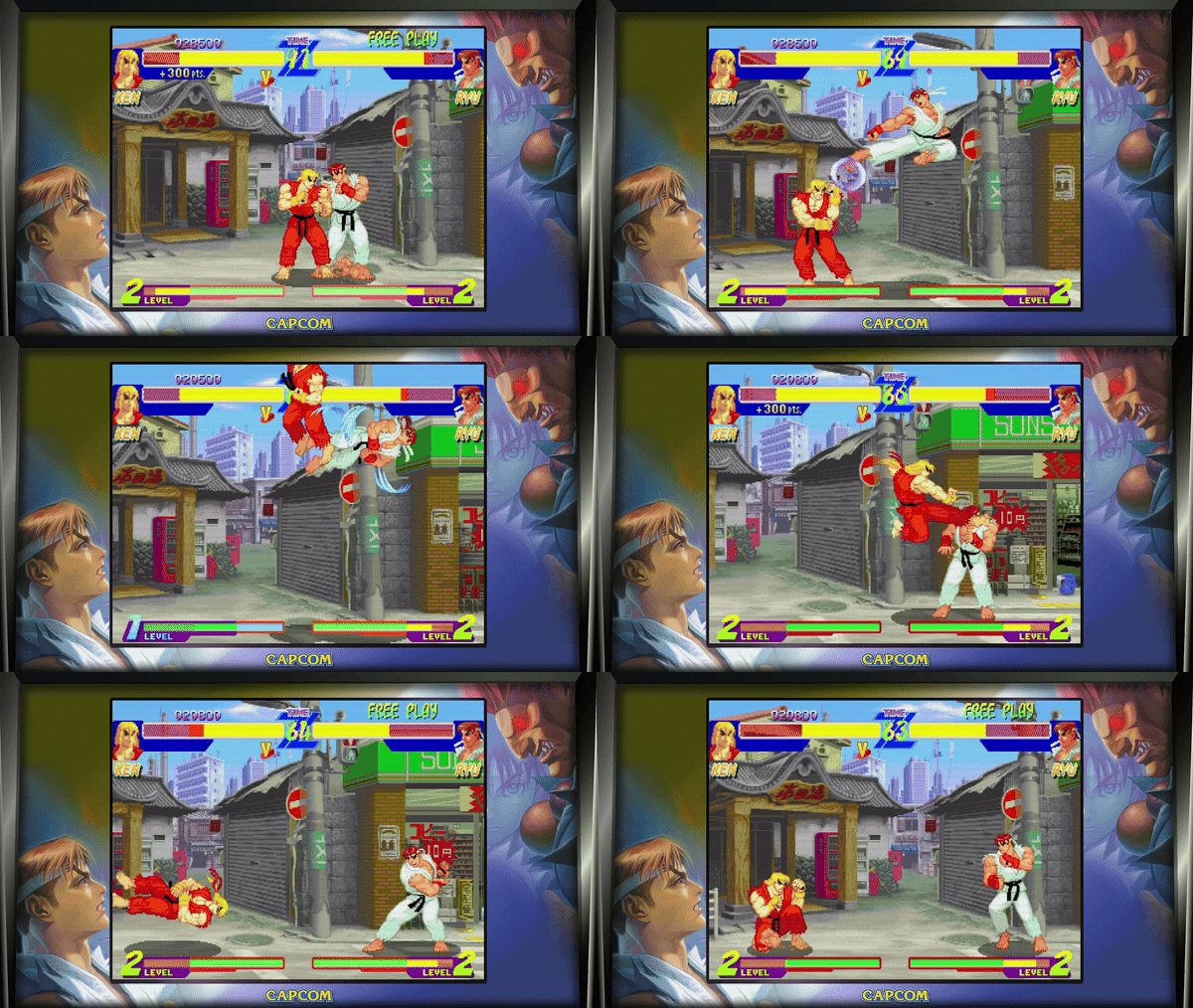
Alpha adopted many of Darkstalkers’ innovative ideas, including the chain combo system, where hitting increasingly strong punches and/or kicks cancels the recovery time of the previous strike and naturally builds branching combos. Chains simulate fighting with multiple limbs, where a left jab easily transitions to a left kick or medium punch, great for landing multiple hits to your opponent. Chains work with SF’s classic link combo system to finish with a special move, and since the three-level meter allows multiple supers per character, you have more situations in which to accrue massive damage. To make up for the increased combo systems, attack values were recalibrated lower to make up for so many coming in quick succession.
Darkstalker’s airblocking significantly changed Alpha, biasing it more towards quick reactions, which paired well against the new air combo system. Of course, air blocking lowered the effectiveness of classic Street Fighter strategies, including Ryu’s famous hadoken/shoryuken combo, which forced players to rethink what they had known for years. The meter-consuming Alpha Counters allow a guarding player to beat back an attack, up to countering a super move, and send the attacker flying backwards. Since the attack requires a quarter circle back to down motion plus a character-specific normal, Alpha Counters sit at the crossroads between technique and meter management. Meter was even applied to recovery states, letting the player pay to land safely from of a throw or roll out of a knockdown, avoiding damage or quickly returning them to the fight.
So far, Alpha’s systems have been to benefit the player’s fidelity of control, giving you a universal toolset you could use on command, but it also bundled offensive and defensive actions into a computer controlled assist system called Auto mode. Chosen at Character select, Auto mode defaults the player to a block state when attacked and all super moves are activated simply by pressing all punches or all kicks. While it makes Street Fighter more accessible to newcomers, it is no less than the game playing itself, which takes resources away from the its focus on performance.

Alpha 2 got more characters from SF, SFII, and FF, and tweaked existing Alpha move lists. At system level, it replaced chain combos with the Custom Combo system that counts the meter down and gives the player four shadow images that repeat all the player’s attacks, quadrupling the hit rate and giving time to reposition and juggle. The new characters and increased archetypes prove the versatility of system-driven gameplay to create modular fighting game profiles where large sections can be swapped out at will, allowing a character to play incredibly differently even between iterations.
As Capcom was prototyping their fighting game formula in 3D on Sony’s ZN-1 / PlayStation system boards, both by hiring the Akira’s new Arika studio for Street Fighter EX and practicing in house with Hideaki Itsuno’s Star Gladiator and Rival Schools, Noritaka Funamizu would become a prolific producer across all major CPS-2 fighting franchises. This perfectly positioned him to fulfill Darkstalkers’ legacy: he combined the assets from X-Men: Children of the Atom and Street Fighter Alpha to create a new subgenre of hyper fighting games with X-Men vs. Street Fighter. Upping the intensity and speed, the 2v2 tag battles were fast and frienzied, as combatants chain combo’d, air blocked, super jumped, called in assist specials, and canceled a Hyper Combo into doubles. The over-the-top gameplay would iterate until almost every Capcom action game was present for the 3v3 Marvel Vs Capcom 2: New Age of Heroes on Sega’s Naomi board. But before Capcom proved that it could run six different characters worth of fighting profiles at once, it tested how many it could load into the same character.
No other Alpha game highlights the power of systems better than Alpha 3, which replaced Auto mode with three selectable “Isms” that allow each player to enter a match with a system profile inspired by earlier SF entries, each with their own stats, special move tweaks, and metered abilities. To emulate the first Alpha, A-Isms provide its three-level Super meter, multiple Super moves, air blocking, and Alpha Counters. V-isms gives you Alpha 2’s Custom Combo system and adjusts attack damage down to accommodate the increased DPS. Inspired by Super Turbo, X-Ism is a single meter mode that removes air-blocking and Alpha counters and increases attack damage and lowers defense, so hits are as valuable as they were in Street Fighter 2. By emulating the previous three Street Fighter games’ systems on the CPS-2, a considerable amount of Alpha 3’s gameplay variety is determined before the match, slotting three gameplay modules for each of the 35 characters, a total of 105 unique profiles, that are run two at a time, one per player.
Street Fighter Alpha’s plug and play profiles show how system level changes can have dramatic effects on a game’s characters and versatility, but it also highlights how varied a franchise can become even within the confines of its base mechanics. Alpha’s air and ground combat continued to be tweaked to let opponents hit in the air be hit again, leading to juggles at different heights, well countered with air recoveries that let that opponent counter the attacker following up. This made Alpha 3 a dynamic, difficult game that easily builds and shifts pressure, and with the SFA3 Upper version that added two turbo modes, adding exaggeration and energy to the more grounded traditional design of the first Alpha. The dynamism and energy is best revealed by the pulse-pounding 1v2 battle between Bison Dolls Juli and Juni, whose Cammy-esque movesets can work in tandem. Only by controlling the space in front and behind, smartly using your specials and Supers so you’re not exposed to one while engaging the other, and fully use the systems available to you, will you come out on top.

DEVELOPER: Capcom
PLATFORM: Capcom Play System 2
1995
Dane Thomsen is the author of ZIGZAG, a sport-punk adventure in a world of electrifying mystery. With the voice of her people as her guide, Alex walks neon purple streets thrown into chaos, wielding the concussive force of her baseball bat the mighty ‘.357’ against the forces of evil. Print and kindle editions are available on Amazon. For sample chapters and to see his other works please check out his blog.
 scriptroutine.com