

If the original Street Fighter represented Ryu’s quest to climb the metaphorical mountain of martial arts mastery through willpower and multi-disciplined training, then Seth, Street Fighter IV’s boss, is the antithesis, an engineered creation that technologically combined the moves of the greatest fighters to leap straight to the top. By SFIII, the series’ core evolved into a deep combat model with flowing hip-hop style, but its complexity made the climb nearly insurmountable for new players at a time when gaming was going through dramatic changes. What was needed was a break until new tech could re-evaluate the series’ design and still capture its artistry. Street Fighter IV returned to the canvas nine years later, able to balance traditional gameplay elements from throughout the series to help fighters at any skill level reach the martial arts’ stunning, stylish summit.
Continue reading “Reclaiming the Peak: The Master Strokes Painting Street Fighter IV’s Martial Arts Canvas”Category: Melee Combat
Toy Commercial Meets Cartoon Maker, Transformers: Devastation Brilliantly Combines Genres into a G1 Powerhouse

The first chapter in Transformers: Devastation showcases the game’s strong design, pitting the Autobots led by Optimus Prime against the Constructicons. Transforming between their bot and alt forms, the Decepticon construction crew is deadly individually and tricky when grouped, and both sides unleash melee weapons and guns before transforming again and hitting turbo. These cool-looking cel-shaded animations allow Devastation to provide the tools to create awesome, exhilarating battles. And as the last Constructicon is defeated, they all combine into the mighty Devastator, helping Megatron cyberform Earth into their home planet, Cybertron. With Transformers: Devastation, Platinum Games provides virtual action figures so players can direct a never-aired episode of the legendary brand’s iconic G1 cartoon with heavy metal soundtrack.
Continue reading “Toy Commercial Meets Cartoon Maker, Transformers: Devastation Brilliantly Combines Genres into a G1 Powerhouse”The Rise of Hyper-Fighting: How Capcom Combo’d Innovative Mechanics Into An Intense Anime Versus Subgenre

Iterating gameplay is a crucial part of the videogame design process to streamline the strong elements and improve the weaker, especially important for competitive genres where devs balance thousands of different aspects to make it fair. But with a game’s subsequent releases, a developer risks changing the base structure too much and making it unrecognizable. For a legendary game like Street Fighter II, which established fighting game’s rock/paper/scissors blueprint, balancing new ideas is incredibly challenging, even for a game notorious for its many revisions. The smart move would be to start with a fresh series to safely experiment with new gameplay, powered by new tech. In the mid 1990’s, Capcom branched out, resulting in more than a dozen games that would not only establish All-Star and Tag-Team fighting games, but create a new standard for a combat system’s actions-per-minute. These games would cultivate a lightning-fast subgenre that captured the spirit of Shōnen anime, complete with fast combat, air combos, and glorious super moves, with the beloved Marvel vs Capcom series its star.
Continue reading “The Rise of Hyper-Fighting: How Capcom Combo’d Innovative Mechanics Into An Intense Anime Versus Subgenre”Mixin’ Knock Out Beats in Street Fighter III’s Hip-Hop Battles

With its rhythmic striking system that hits at different heights, Street Fighter‘s combat system was expanded to become a branching, freestyle duet in SFII, sung by the sound effects and character voice samples. After Street Fighter Alpha’s swappable systems pushed the series’ fighting game formula to it’s limits, Capcom streamlined its base mechanics and meter functions for Street Fighter III, using the CPS-3’s CD format for gritty, stylized art on detailed stages against a funky soundtrack. Street Fighter III: New Generation’s refined mechanics maxed its beats per minute and rewarded improvisation, turning it into a fluid hip-hop fighting game.
Continue reading “Mixin’ Knock Out Beats in Street Fighter III’s Hip-Hop Battles”The Warriors’ Dream: Analyzing The Alpha Systems That Transformed Street Fighter

A lot of thought goes into a videogame sequel to progress the gameplay and characters of the original, but its changes need to justify their existence while capturing the original’s intent. So, how do you meaningfully expand on a game like Street Fighter II that defined fighting gameplay, especially when its constant revisions resulted in five major arcade releases? One trick is to build new systems over the core gameplay, useful for when a genre like 2D fighting needs to modify elements without having to redraw character animations. Street Fighter Alpha shows how modular, swappable systems can dramatically change the foundation they are built onto, its new mechanics adding depth to Capcom’s fighting game formula while dramatically improving the presentation to create exhilarating, anime-caliber battles between fast, fluid, and powerful characters.
Continue reading “The Warriors’ Dream: Analyzing The Alpha Systems That Transformed Street Fighter”Training New World Warriors in Street Fighter’s Dojo

Street Fighter’s shotokan style was an important first archetype for a 1v1 fighting game and introduced Ryu and Ken to the world, but the game had too many weaknesses to sculpt a complete, well-rounded martial artist. Like a body maturing, its strength multiplying and nervous system connecting every part, it wasn’t until Capcom’s arcade hardware improved that it could fully realize the fighting depth and dramatic spectacle to which the original game aspired. But three and a half years would prove fruitful training time to address SF’s faults, and the result revolutionized videogames forever and debuted an iconic cast of diverse fighting styles. With its improved animation system, new character archetypes, and a third core mechanic that brilliantly merged the gameplay, Street Fighter II: The World Warrior’s eight playable fighters helped solidify Street Fighter’s martial art, and took its digital dojo global.
Continue reading “Training New World Warriors in Street Fighter’s Dojo”Devil May Cry And How Character Action Burst Onto The Gaming Scene In Style

The character action genre is hard to fully define considering how wildly different one title can be from the next, but it largely comes from the stylish combat defined by Capcom’s 2001 milestone, Devil May Cry. DMC’s action design was so strong that it could seamlessly transition between melee and ranged combat, where you can launch an enemy into the air with your sword and juggle them with gunfire. These fast fights are made from a simple yet complete moveset that works well at different distances. Director Hideki Kamiya translated hack ‘n slash games and brawlers into three dimensions, emphasizing twitch action and fair but challenging difficulty by imbuing it with fighting game mechanics and systems that grade your performance in real time. It offers players the means to create spectacular combat sequences where the goal isn’t just to defeat your enemy but to stylishly wreck them.
To understand how it all came together, we have to look at DMC’s family tree.
Continue reading “Devil May Cry And How Character Action Burst Onto The Gaming Scene In Style”Scoring Devil May Cry 4’s Smokin’ Sick Style

Devil May Cry may be revered for merging fighting game’s pugilist science with brawler’s crowd management, but it was driven by its arcade-inspired scoring system. Dedicated fans can easily spend dozens of hours honing their skills against the game’s difficult enemies and massive bosses, all to improve their final scores. With DMC3, Hideaki Itsuno expanded the single player fighting game’s combat and worked in replayable missions. When that amazing foundation jumped to the PS3 and Xbox360 for the fourth release, Itsuno could further distill the series down into an arcade experience and offer new characters for those chasing that high score high. Let’s look at how it succeeds.
Continue reading “Scoring Devil May Cry 4’s Smokin’ Sick Style”
Devil May Cry 3: Bearing Witness To Dante’s Awakening
On Characterizing Potential
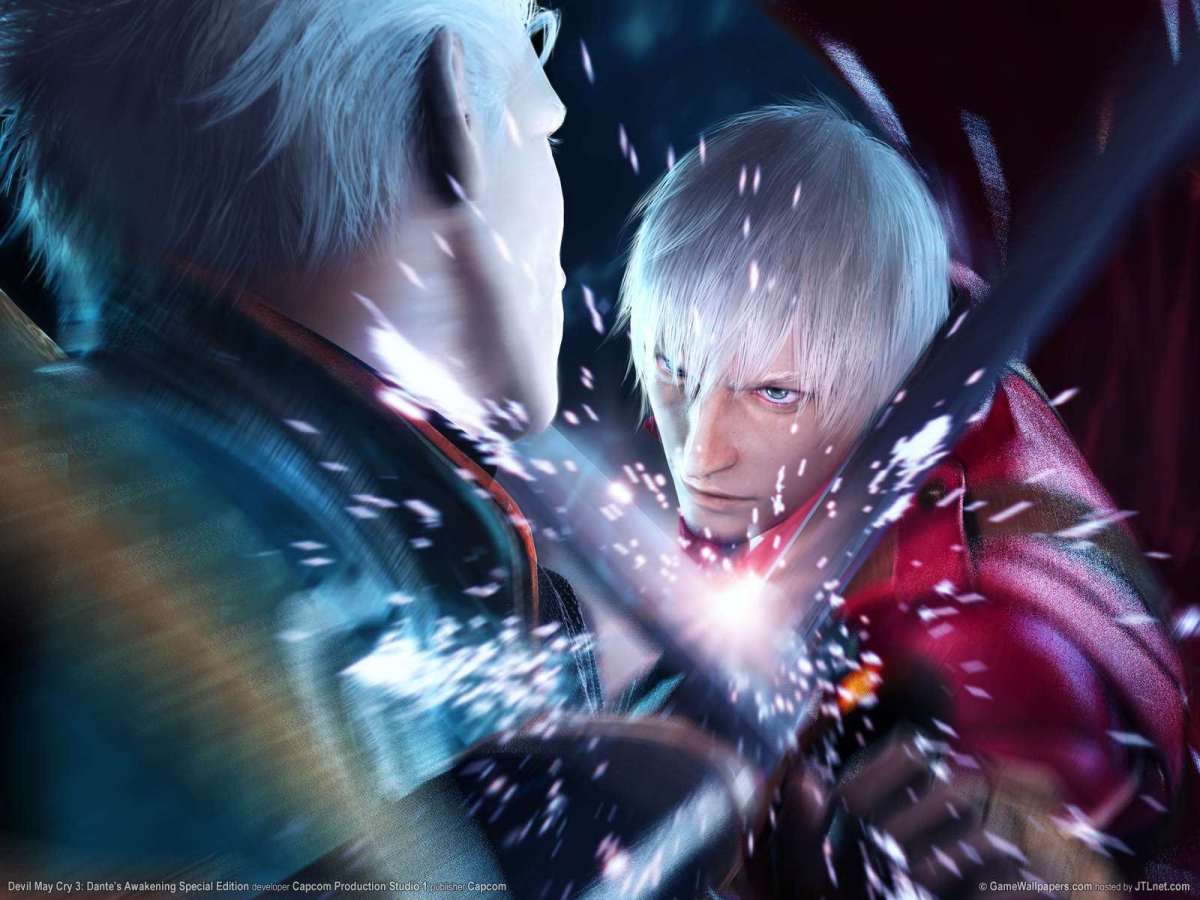
Devil May Cry 3’s first fight between the twins Dante and Vergil is set at the highest point of a large tower jabbing from the Earth, lit by the full moon. The differences between the brothers’ fighting styles are as striking as their fashion senses, the hot-headed Dante in his red trench coat unleashing his Rebellion sword and dual pistols a contrast to the cool-as-ice Vergil in his blue jacket and air slicing katana, Yamato. The two rivals clash swords and exchange gunfire, taking advantage of any opening in the other’s defense to chop ‘em down. And then they flaunt their success with a cool taunt, unconcerned by the time it takes to mock their opponent. Every second of this brawl is intense and fast, and, by product of the game’s design, requires the player to fully realize the personalities of the sons of the legendary demon warrior Sparda.
Continue reading “Devil May Cry 3: Bearing Witness To Dante’s Awakening”
With the Awesome Might of God Hand, I Smite Thee

God Hand’s penultimate fight pits Gene against his rival Azel in a knuckle-breaking slug-fest that demands that the player understands every pillar of the games mechanics. To stop him from resurrecting the ancient devil Angra, you need to pick and choose your moves to beat his, to reposition to gain a tactical advantage, and to bob and weave around counter attacks that can lead into a button mashing power struggle you’ll feel all the way down your arm. And just like main character Gene, Azel can activate the supreme powers in his arm and execute a fast-action barrage thanks to his God Hand. To beat him, you need the full cooperation of a focused mind and tuned body.
Continue reading “With the Awesome Might of God Hand, I Smite Thee”
 scriptroutine.com