Splicing Gen(r)es: Investigating Resident Evil’s Survival Horror

A Biohazard Outbreak

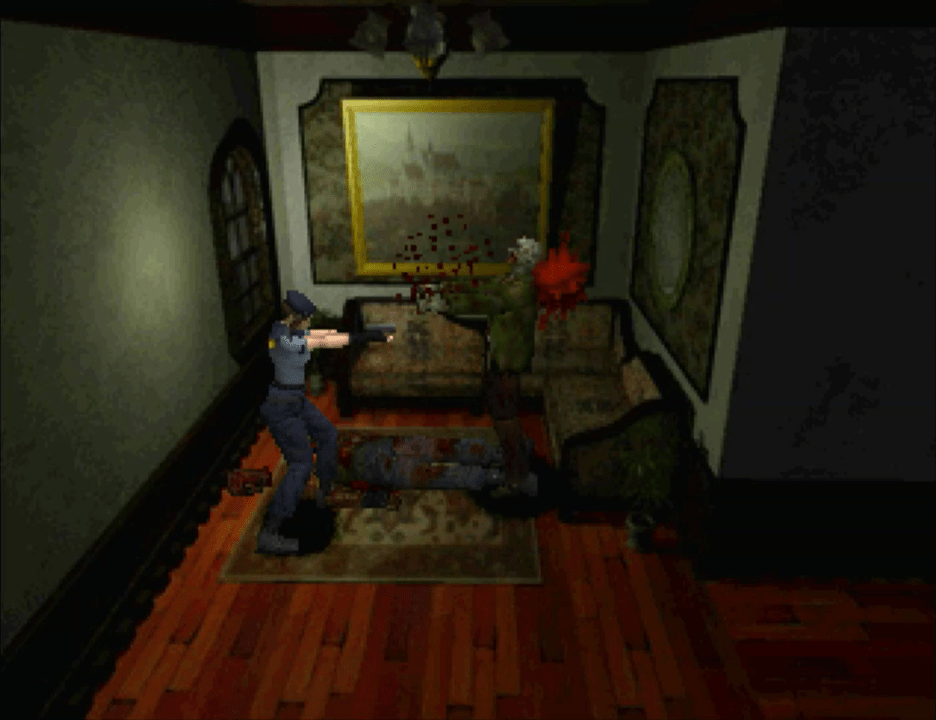
When Special Tactics And Rescue Squad’s Bravo team goes dark in Raccoon City’s Arklay Mountains while investigating grizzly murders, the Alpha team rescue party finds itself in a firefight against bloody claws and gnashing teeth, a scene Resident Evil brings to life with real actors dashing through the woods towards the safety of Spencer Mansion. Though primarily told through cinematic in-engine cutscenes framed by an static camera system, this live-action scene transitions the player into the B movie game’s world filled with zombies, mutated dogs, giant spiders, and, at the end, the perfect bioweapon, manufactured by the international conglomerate, Umbrella Inc. A controllable, branching B horror movie starring S.T.A.R.S.’ Chris Redfield or Jill Valentine and supporting characters, Resident Evil tests your delicious brain’s skills to survive a different kind of haunted house, discover the truth about a biological outbreak.

Continue reading “Splicing Gen(r)es: Investigating Resident Evil’s Survival Horror”

The Rise of Hyper-Fighting: How Capcom Combo’d Innovative Mechanics Into An Intense Anime Versus Subgenre

Iterating gameplay is a crucial part of the videogame design process to streamline the strong elements and improve the weaker, especially important for competitive genres where devs balance thousands of different aspects to make it fair. But with a game’s subsequent releases, a developer risks changing the base structure too much and making it unrecognizable. For a legendary game like Street Fighter II, which established fighting game’s rock/paper/scissors blueprint, balancing new ideas is incredibly challenging, even for a game notorious for its many revisions. The smart move would be to start with a fresh series to safely experiment with new gameplay, powered by new tech. In the mid 1990’s, Capcom branched out, resulting in more than a dozen games that would not only establish All-Star and Tag-Team fighting games, but create a new standard for a combat system’s actions-per-minute. These games would cultivate a lightning-fast subgenre that captured the spirit of Shōnen anime, complete with fast combat, air combos, and glorious super moves, with the beloved Marvel vs Capcom series its star.

Continue reading “The Rise of Hyper-Fighting: How Capcom Combo’d Innovative Mechanics Into An Intense Anime Versus Subgenre”

Going Maverick: How X4 Upgraded Mega Man’s Hardware

Depending on whether you chose to play as X or Zero, the fight against Web Spider requires a different set of tactics. With his X-Buster, X can dash around the small jungle room until Spider descends from the canopy, wall jumping over the webs he shoots and firing from afar. With his Z-Sabre, Zero is forced to stay close to the bug on his line, dashing away from the web only to careen up and around over it in a circle and strike before your foe scrambles back to safety. The fight gets harder when the Repliforce member lays an electric grid and starts scurrying about the scene. Because of their different playstyles, the remaining seven robot masters will present X and Zero with a similarly different dynamic that test what the two machines, and the player at their controls, are made of.

Continue reading “Going Maverick: How X4 Upgraded Mega Man’s Hardware”

Policenauts’ Mise-En-Scene

Policenauts was the perfect game to introduce the world to Hideo Kojima’s visual style and keen eye for editing a trailer. Unlike other games at the time, every screenshot from the 1994 ‘Interactive Movie’ could have been ripped from an anime, this one the tale of a man lost in space for the first twenty five years of humanity’s move into off-world colonies. It’s Lethal Weapon in the Gundam timeline with an Aliens setup, starring a blue-haired Mel Gibson. The trailer claims Policenauts is ‘The Next Generation of Snatcher’.

Continue reading “Policenauts’ Mise-En-Scene”