
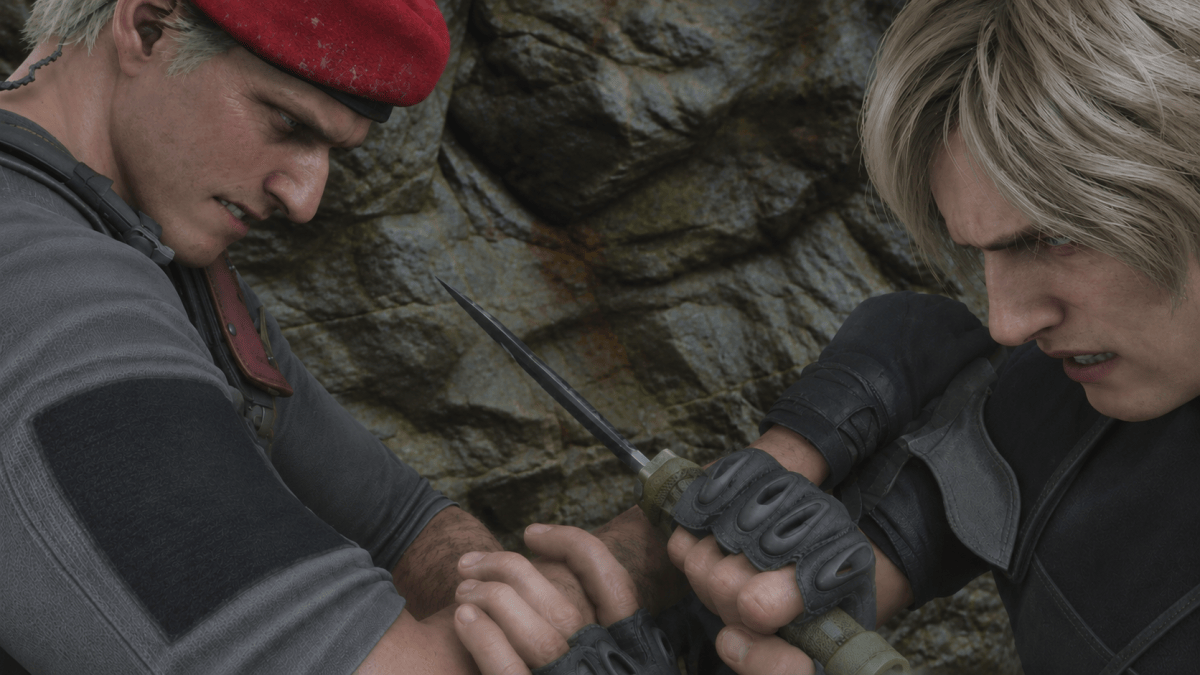
A key Resident Evil 4 boss battle reveals Capcom’s ambitions to recast RCPD officer Leon S. Kennedy into a cool action hero in the increasingly over-the top cinematic franchise: the knife fight against his urban warfighter mentor, Jack Krauser. Until then, his mission to save the U.S. President’s daughter, Ashley Graham, from a cult of smart, reactive Los Ganados enemies had been supported with a fully-loaded arsenal and a new fast-paced, trick shot gameplay. Here, Leon and Krauser unleash precise slashes and stabs, execute intense parries, with life and death inches apart. But where technology limited Shinji Mikami’s 2005 original to only script this as a QTE scene, the 2023 remake, rebuilt with a comprehensive knife-based melee system, turns it into a real-time, personal brawl. By scaling the knife play down where the original scaled the gunplay up, Yasuhiro Anpo and Kazunori Kadoi continued using their Revelations 2 design experience to retrain Leon into an expert in guerilla warfare, reworking the combat economy, and fully transforming the rookie into a battle-hardened veteran.
The Resident Evil remakes solidified into their own branch in the series with 3, a traditional, complementary path to RE7 and 8’s first-person POV, with each remake focused on expanding the core gameplay theme of the original title it was based on. If Resident Evil 2 remake modernized RE2’s controls for brutal in your face survival horror and 3 made it into a scripted action movie with evasive maneuvers, then 4R needed to build off OG 4’s design as much as that game built off the classics. Since the gunplay had incrementally evolved over the series after 4, it made sense to renew focus on knife combat, as the OG’s blade possessed surprising depth despite its supporting role, and when combined with how the remakes turn the item into a consumable, has significant impacts on the survival horror gameplay.
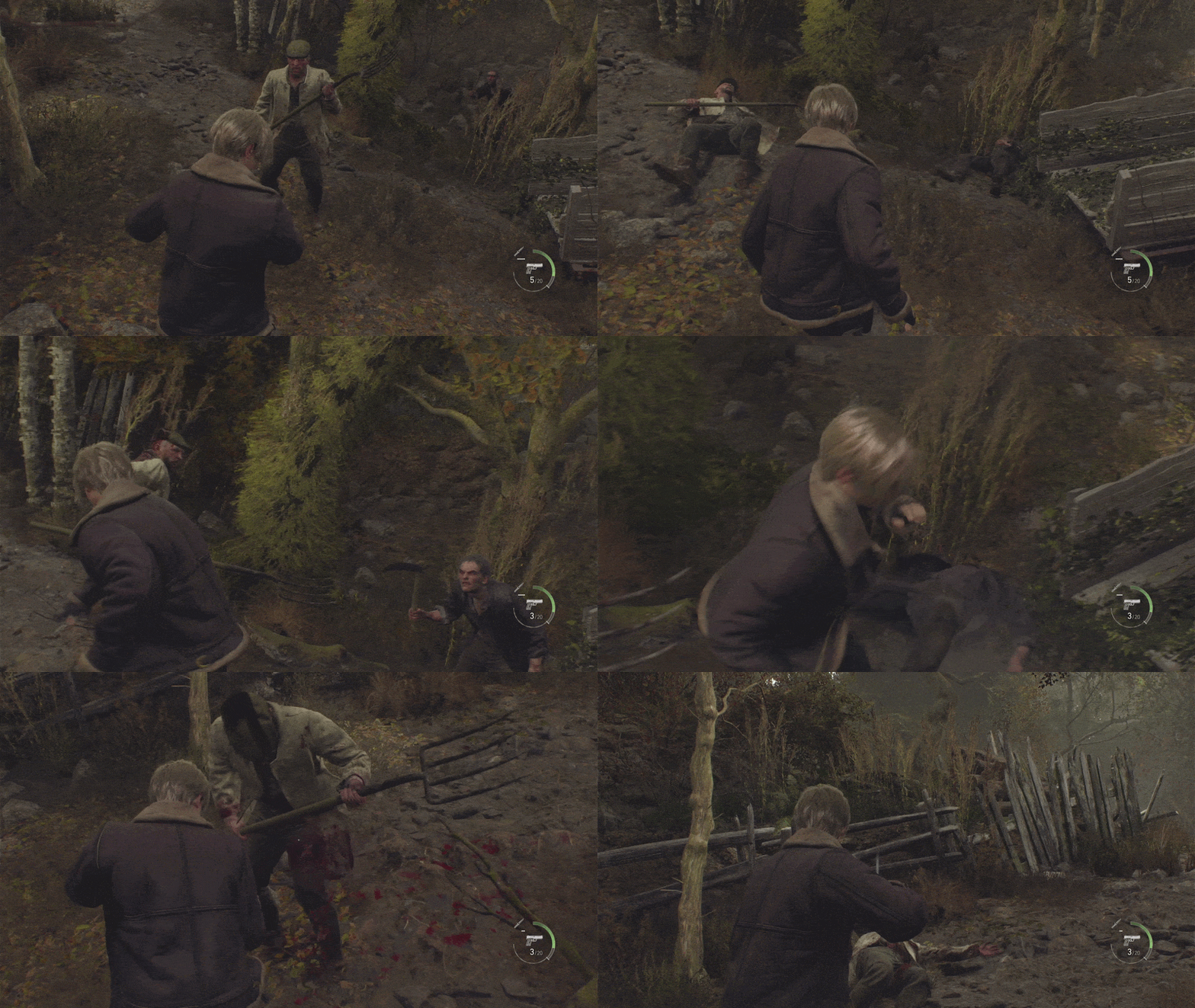
Resident Evil’s action era defined tactical third-person shooting, whose gameplay is about controlling space between combatants and the angles that connect them. Gunplay is relative to Leon’s view, who aims within a bounding box that turns when it reaches the screen’s edges rather than shot from a reticle relative to the player’s view. Location-based damage allows him to stun and trip oncoming enemies and follow up with a melee attack or shoot projectiles out of the air, which create dynamic situations where performance impacts resource management and determines success. Remake 4 brings in Remake 2’s modern controls with weapon shortcuts and strafing. Both designs allow for personal, close combat that work at different scales, but Remake 4 radically increases the OG’s legendary variety.
Anpo and Kadoi had designed most of the knife combat in Rev 2, putting slash on R2 that served contextual functions. In 4R, slashes can disorient enemies and interrupt their animations, and the precision stabs from readying the blade with L1 allows for more targeted damage. As with Remakes 1 and 2, the knife can be used to break out of grabs, which subtracts durability until it breaks. To even that out, boxes and barrels are now punched and stomped. The knife can be repaired and less powerful backups can be stored. These simple moves create a complete offensive profile, but that’s just one aspect of the revised gameplay.
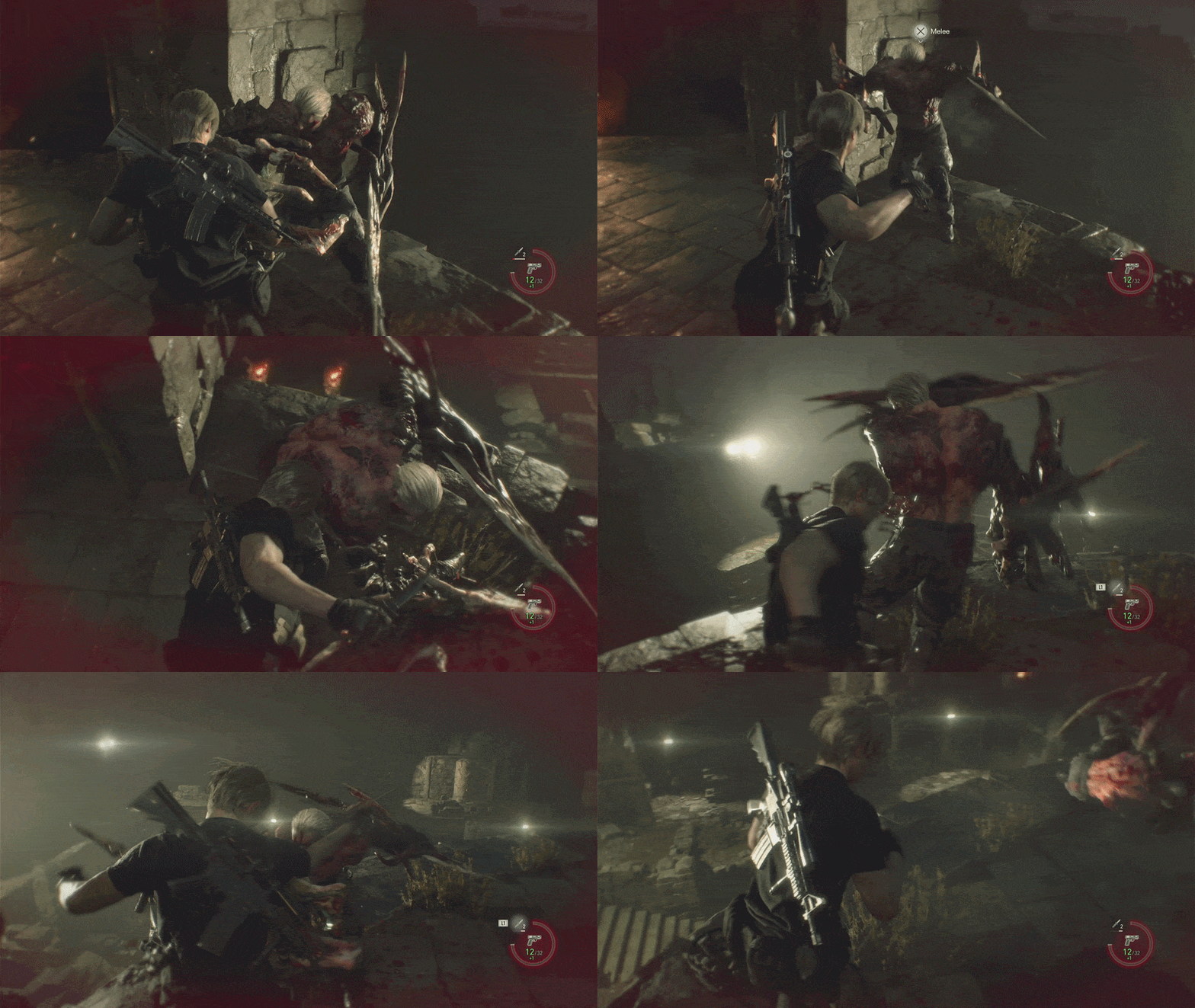
Just as important to the melee combat is the powerful parrying mechanic, where hitting L1 when attacked will safely deflect it. The move’s generous timing window is balanced out by only working if facing the attack, while a perfect parry stuns an enemy long enough to kick them away. This drastically increases the close quarters options, necessary when it’s so easy to get overrun. Leon’s parries differ from the evasive moves of past games, keeping Leon stationary to easily counterattack, rewarding confident use. Since enemies attack independently, melee combat becomes a rhythmic game of quick strikes and counter attacks, that creates the space required to reposition and reset. The combination of new offense and defense options don’t require massive manual dexterity alone, but RE4R’s intense, frenetic battles become complex enough to require layers of skill.
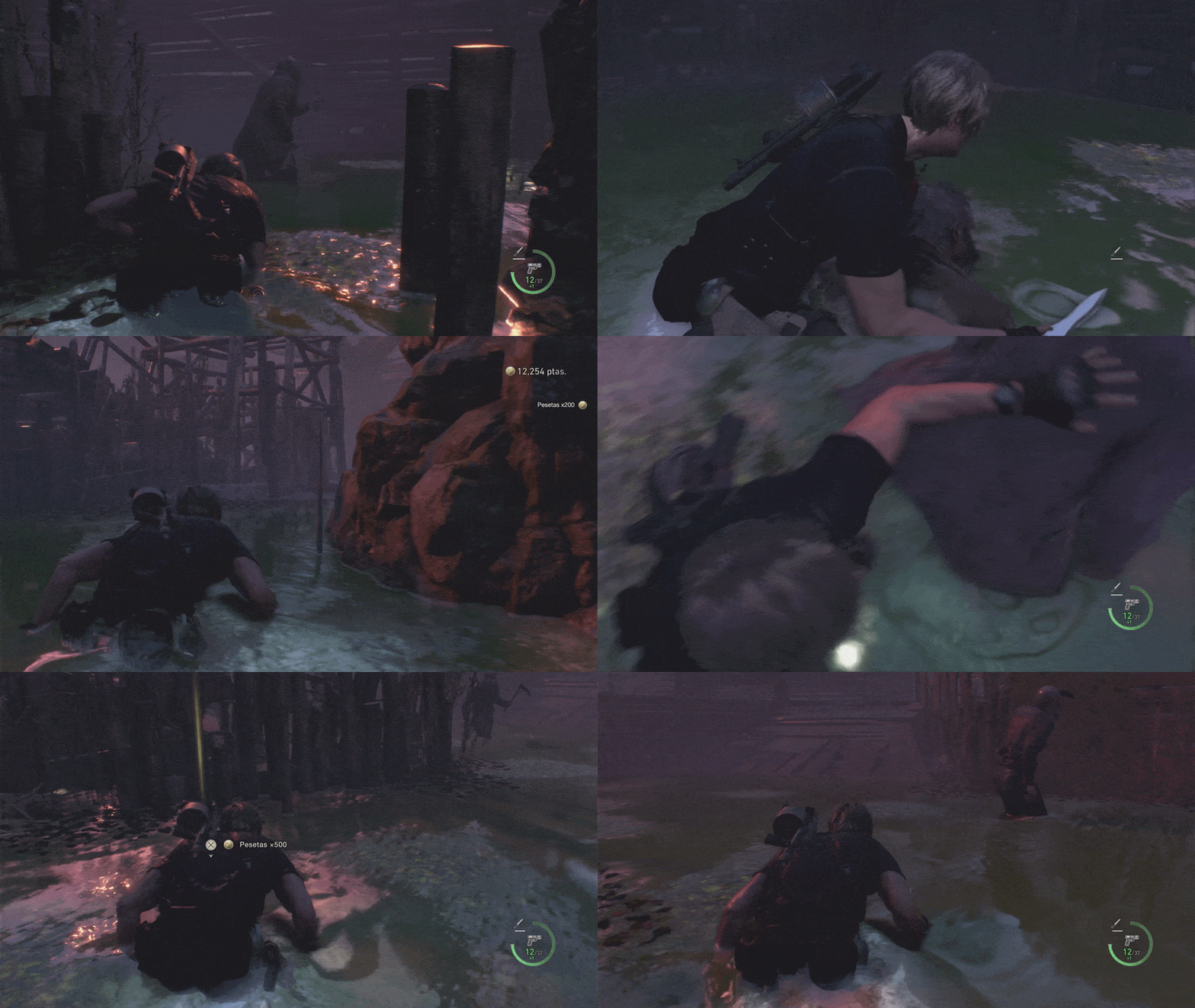
Probably the most significant large-scale change to Remake 4’s gameplay is how it reframes Leon as a deadly hunter, integrating the crouching movement and resulting stealth gameplay, which comes with knife takedowns. Maps become puzzles that can be silently solved, finding the best route to unsuspecting targets. This stealth gameplay radically transforms RE4’s classic arenas and scenarios, providing players with new ways to unlock combat encounters- they build alternate paths through areas and give new ways to control a map. This also works well with the area alert system from the original game, where enemies would often be passively working in an environment until you get spotted or made enough noise, and then every enemy within range descends on your location. The Bolt Thrower rounds out Leon the hunter, regular bolts silent killers and proximity mines great to draw attention or protect your location. Stealth makes sense on conscious enemies, like 4’s Ganados and Rev 2’s Afflicted than Resident Evil’s classic zombies, and so it offers a different Leon, a different game, than 2019’s RE2R, turning gameplay revision into genuine character development.
While Leon’s new mechanics alone create a variety of different scenarios, the enemies change up the threat prioritization within them. Standard enemies behave at different ranges and weapon types, but new parasite mutations can bring dead enemies back to life and stronger than before, unless they can be executed before they get back up. In many ways, this mutation is like RE1R’s crimson heads but spawning on a much shorter interval. Resident Evil has always centered around resource management, forcing players to juggle priorities within a shifting economy of ammo, health, and enemies, and this remake has found new ways to make time even more valuable. In fact, the gameplay is purely comprised of limited resources, with the shooting requiring ammo and the melee depending on a knife. The game ends on the island, where Leon’s skills are tested in a densely packed military compound, an army of mutant soldiers between he and Ashley.
With Resident Evil 4 Remake, Leon became a complete warfighter that combined a trick gunplay system with comprehensive melee mechanics, creating a deep combat profile. This allows the second Krauser battle be much more complicated, Leon fighting off his demented mentor through booby trapped ruins. And then at the end, Krauser mutates blade arms that block and attack, each slash parry-able, opening him to counters and massive damage. It’s an evolution of the original’s amazing boss battle, even evolving elements from their last brawl. Resident Evil 4’s remake completed Leon S. Kennedy’s training into an action hero powerhouse, and directors Anpo and Kadoi confidently embedded a versatile, tense combat system so strongly at the core of their horror game that It became the theme for its haunting end credits song, the wistful, Spanish guitar tune “The Bullet and The Blade”.
DEVELOPER: Capcom
ENGINE: RE Engine
2023

