
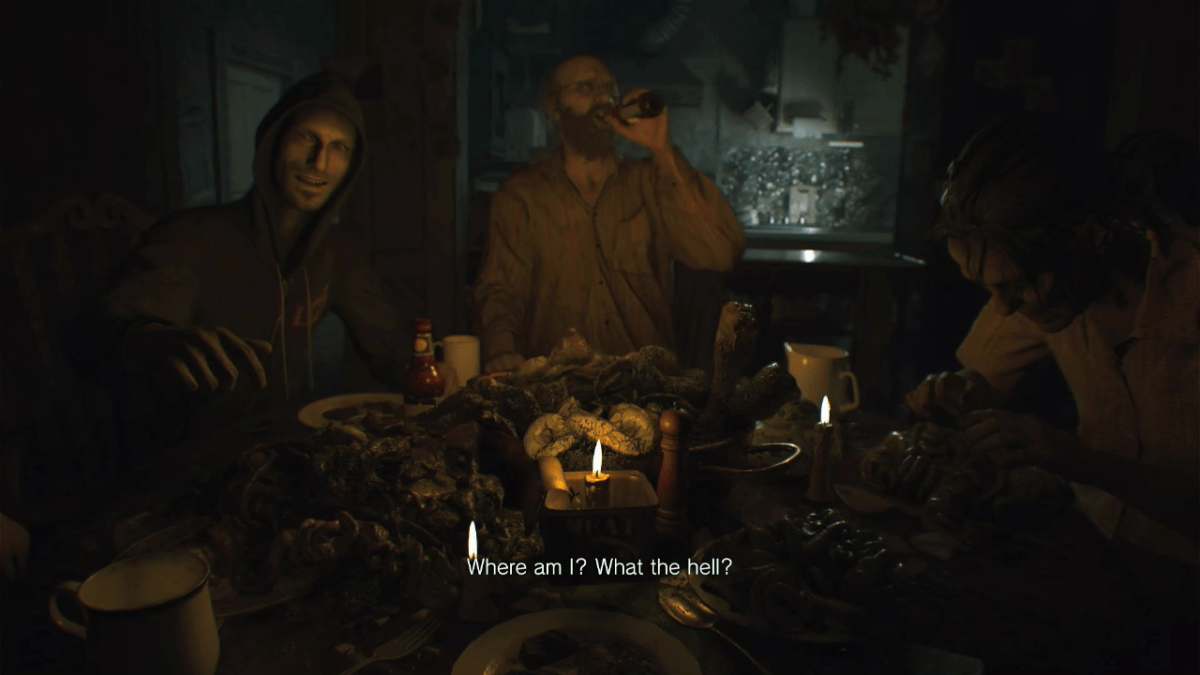
Shortly after trespassing into the abandoned Baker estate, you wake to find yourself sitting at the dining table surrounded by the family of psychotic redneck owners, the left hand that you’d just had chopped off stapled back on. It’s a surprising setting for a Resident Evil game, not only because you’re watching it all from protagonist Ethan Winter’s eyes, but because it fundamentally flips the series’ central ideas on their heads while being loyal to the core design. Rather than taking inspiration from schlocky western zombie flicks, Resident Evil 7 viewed its haunted house item progression and Condemned-esque first-person investigation gameplay to solve a country horror mystery inspired by Texas Chainsaw Massacre. Ethan escapes after dinner and kills Jack Baker when his car explodes, only to be grabbed again by fast healing Jack who blows his brains out for you in a show of his power. It’s here that the player realizes that Resident Evil 7: Biohazard, with its willingness to rethink the series on a cellular level, represents a different kind of coming back from the dead.
Since Resident Evil released in 1996, its gameplay dramatically evolved around its core concepts, but after 6’s multi-campaign, globe-trotting action horror movie spectacular, the series lost sustainability. Luckily, Koshi Nakanishi’s co-directed Resident Evil: Revelations had taken the opposite approach earlier the same year, splicing a contemporary third person shooter design on classic RE level structure, making it easier to integrate a first-person aiming mode as a mainline mechanic. Redesigning let Nakanishi and team translate RE into first person in a way the PlayStation’s RE: Survivor could only wish, suitable for a series built by its perspective, but different enough to justify subsequent changes. The series’ first title built on Capcom’s RE Engine, Biohazard brings Ethan to a Louisiana river estate after receiving a message from his long-disappeared wife, Mia, but only gets weirder after she gets possessed and chops off your left hand with a chainsaw, ranting about how she’s with her real family now.
Shinji Mikami’s original greatly closed the gap between game and movie by smartly choosing static camera angles that framed important information in rooms with points of interest. It was a playable B film built of unique angles. Nakanishi reworked the spirit of this framing to his new perspective by having all events stay in first-person, character interactions happening in real time. This went a long way to connect players to the physical place, as do animations where Ethan is interacting with things with his hands, pressing buttons, holding objects, all making the world seem tangible. This change allowed the game to emulate different styles of the classic game genres that had inspired it, such as the dungeon crawler, graphical adventure, and shooter. The result is a stylish sequence of events happening to you rather than in front of you. It also makes diving into the unknow Baker mansion more enthralling.
The dungeon crawler genre predates videogames, providing the means to investigate dank labyrinths stalked by monsters, and due to technological limitations, early game renditions like Wizardry and Ultima assumed a first-person perspective to maximize immersion and atmosphere. After mainstream titles like Elder Scrolls, Condemned, and Amnesia: The Dark Descent offered similar adventures, the genre was in great shape for RE’s progression. So instead of creeping through mazes stalked by a minotaur, Nakanishi had Papa Baker hunt you, forcing you to hide, run, or fight, while you raid supplies and secret passages in densely detailed rooms that you can now see in great fidelity.

The series’ increased action elements sacrificed the sense of vulnerability that defined survival horror, as it’s difficult to be afraid of what lurks in the shadows when you could just dodge its attack, shoot it in the head, and then roundhouse kick it into a wall. Revelations 2 recaptured that terror by covering the world in shadow and scaling down the melee attacks, but Biohazard takes this further by making ammo scarcer and not pausing the game when checking your inventory. Shockingly violent scenes stay with you, layering terror over even quiet moments.
The addition of sneaking in Resident Evil 7 has an interesting psychological impact, as learning you can duck and that enemies react to noise is tested in the early sequence where you evade Jack by creeping through rooms and blocking line of sight by closing doors, but then you carry on that cautious behavior as you investigate the house, even after the need has disappeared. That getting injured causes Ethan to flinch and gasp helps portrays him as a weaker protagonist than RE has seen in a decade plus. RE7 comes with more tense gameplay as a natural product of the POV, making the back you never see feel like it could be attacked at any minute, exactly when a black Molded monster shambles up to you from behind.
The combat economy is a fundamental aspect of Resident Evil, acquiring and using weapons and ammo as efficiently as possible. The arsenal here is well-rounded and ammo scarce enough to require wide proficiency, while the delay to focus the reticle when aiming adds to the combat math. To keep with the renewed vulnerability, it stripped gunplay tactics while leveraging the location-based damage and changes in enemy behavior based on it’s wounds to keep scenarios dynamic. The addition of the L1 block adds a new defensive beat to pace out the offensive gameplay, each encounter creating different fight rhythms depending on enemy makeup. Each Molded offering different, if not generic in totality, behaviors- the standard and heavy types, the dog equivalent. What’s noteworthy is the enemy weight, which lets them take considerable hits before flinching, removing the security of distance, adding considerable tension to simple encounters.

The hunter archetype’s been in the series since the first and continued developing with the Nemesis pursuing between rooms. With different sections of the property controlled by a different family member, the house is separated into distinct themes. Jack prowls the guest and main houses, and like RE2’s Mr. X and Nemesis in the classic games, only gets downed temporarily when killed, maintaining danger in even familiar areas. His wife, Marguerite, protects her family by giving birth to hornets that swarm unwanted visitors. Each Baker hunts in their own way.
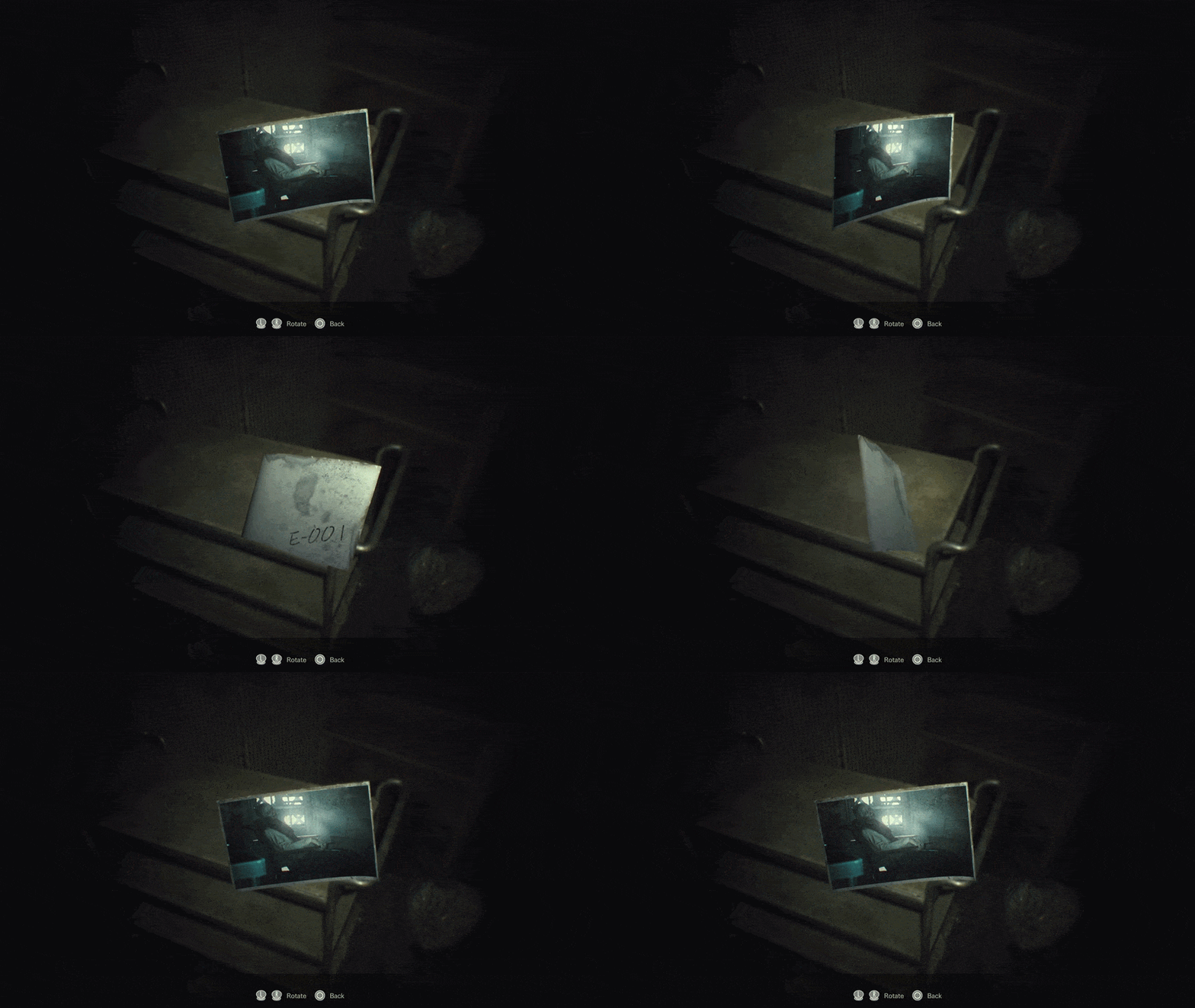
Because Resident Evil used polygonal models set against high-res background images, making interactive objects stand out easier, items needed to be hidden in the environments in different ways, inevitably training players to rub the walls and smash X to find obscured pickups. But that wasn’t the case with fully polygonal worlds where all objects are made of the same material, the cohesion creating naturalness, which, when paired with a first-person view, finally provided, by default, the fidelity and interactivity provided by previous games’ Examine mode. This cohesion is pivotal to shaping the investigation gameplay. The lock-and-key structure does a good job routing the player between interconnected areas, pacing out its environmental and combat puzzles. The Baker Mansion is a cluttered, ugly, mess, an expression of the tenants, extensions of their personalities, rather than a functional, logical (for RE) location like the police station or labs.

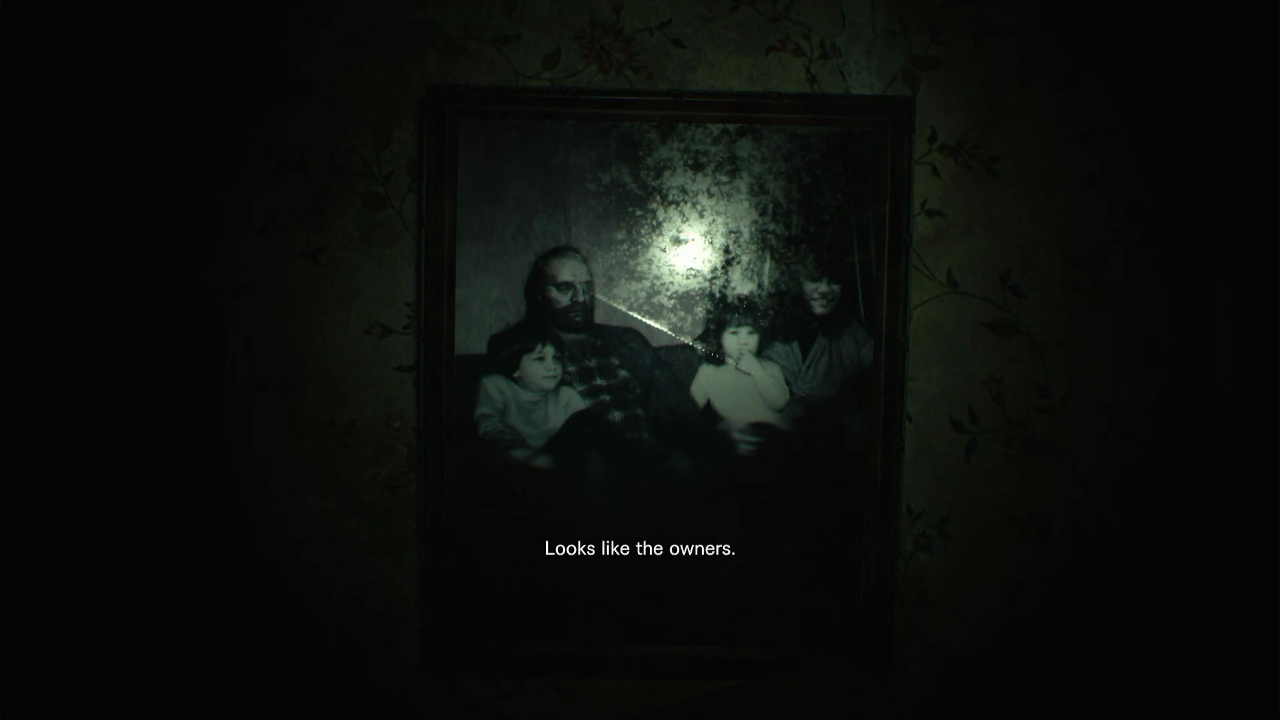
By rewinding to the haunted house setting, Biohazard created a great sense of place, using it to define the Baker family, giving us access to their rooms and history, interests and behaviors. It’s a place of insanity, its structure as broken and rotting as the once-normal inhabitants. Of course, the story is fleshed out with files and items, and finding VHS tapes strewn about are an interesting, non-sensical way to add more perspectives and life to the narrative, showing the tragic end to those who dared enter uninvited. A continuous map that never loads, the location its own puzzle box revealing its mysteries with every opened lock. Lucas’ booby-trapped section of the house distills the structure down and throws a heap of sadism, with the Happy Birthday tape showing how he plays with his victims physically and mentally, a representation of the game itself.
The most intense combat scenarios are the handful of boss battles. While Jack’s is initially a simple fire fight in the garage as he comes after you, the car in the center offering a great mobile weapon, one turned on you if you’re unable to snag the key and buy time to get the starter working before he rips you out and does it himself, and your second brawl turns into a brutal, if somewhat unwieldy, chainsaw duel. The spider like Marguerite is a great fight, the most RE4 like in the game, waged in the wreckage of a back house where she can climb through small spaces and stalk unseen. These are brutal, in your face fights staring directly into Death’s eyes.
Overcoming the Bakers leads us to the truth of the incident- Mia had been there since the transport ship she was smuggling a young psychic test subject into America on crashed when she her mod killed the crew, fleeing to the shore and twisting the family living nearby. It’s a premise made famous by Jerome Bixby’s “It’s a Good Life” and reused many times over, a twisting of family by a monstrous child with more strength than kindness. It’s a story one step separated from the corporate bioterror for which Resident Evil had become famous, focusing on small scale, personal horror and collateral of the larger conflict.
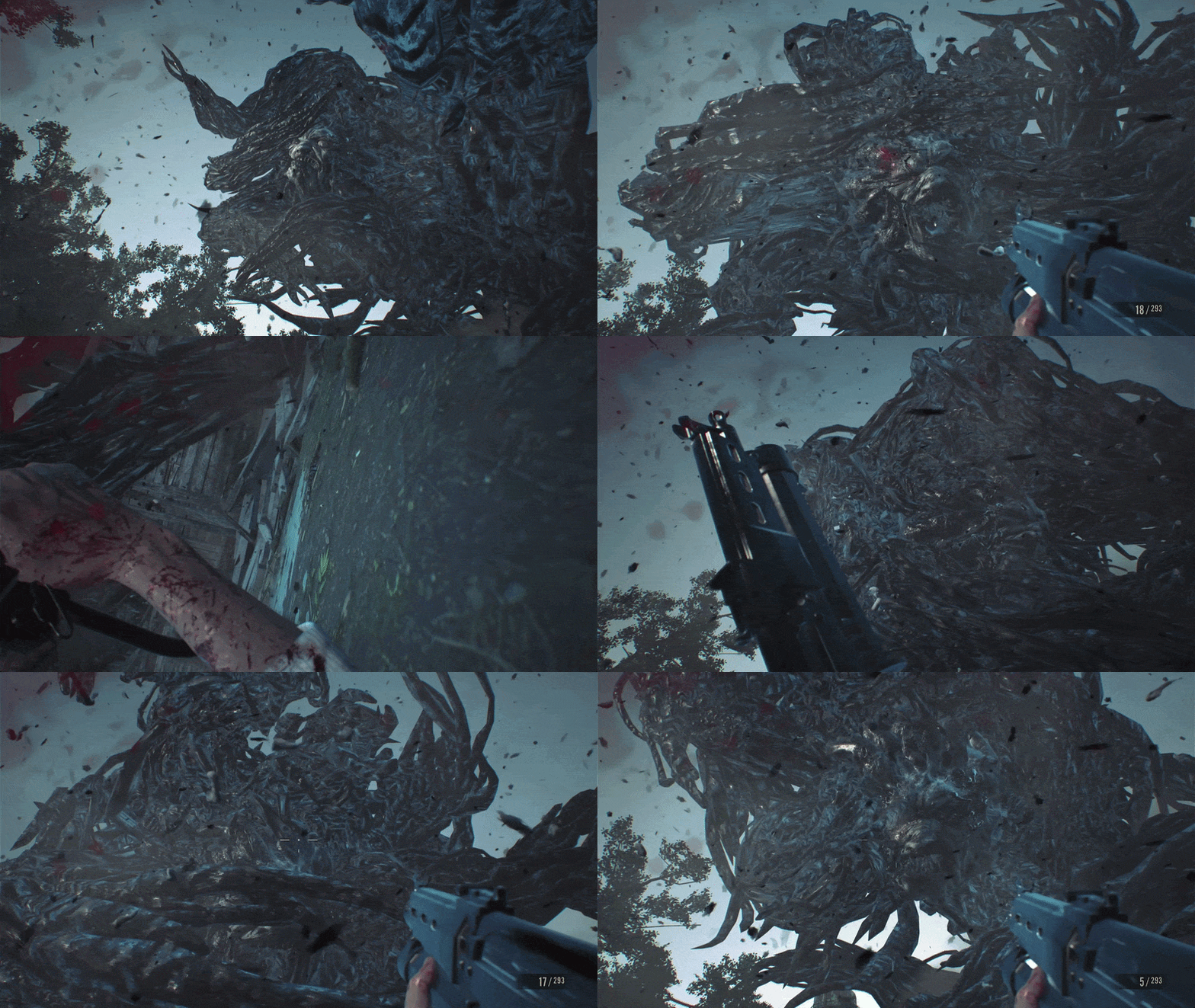
Since the classic games were designed to ultimately be unlocked, from levels to gameplay skill, the fear of the unknown transforms into familiar security. The versatility of the game popularized custom challenges like no recovery items, time attack, or knife only runs for those seeking mastery. The last thirty minutes finally bridges the story to RE’s larger lore, when special forces arrives at the estate. As you face Eveline, unloading every round you have, things look bleak until BSAA agent Chris Redfield tosses you a powerful weapon from his helicopter, connecting you to the original Resident Evil’s finale, made stronger as you’re whisked away by his helicopter afterwards, maybe even with your partner if you were able to save her.
The DLC is where Nakanishi could mold individual elements of Resident Evil 7’s base gameplay in unique ways, further proving the gameplay’s versatility. “Banned Footage” shows the doomed fate of the camera man who stumbled into the Bakers, with interesting survival and adventure modes. The main story DLC “Not A Hero” starring super agent Chris Redfield and “End Of Zoe” with hardened bayou boy Joe Baker focus on building out the shooting and brawling gameplay, adding RE4’s melee follow-ups on stunned enemies and ramping up the action and intensity, each part so reminiscent of Monolith’s horror work F.E.A.R. and Condemned 2: Bloodshot that the whole seems inspired by them. The VR mode finally completes the design Revelations wanted with its 3D, breaking the walls separating you from its crazy world. All this shows that Resident Evil 7: Biohazard carries on its important lineage, showing how a design can evolve, each addition possessing the ability to transform the family tree.
Developer: Capcom
Engine: RE Engine
2017


One thought on “Biohazard Coming Home: When Survival Horror Returned for Resident Evil 7’s Family Reunion”