
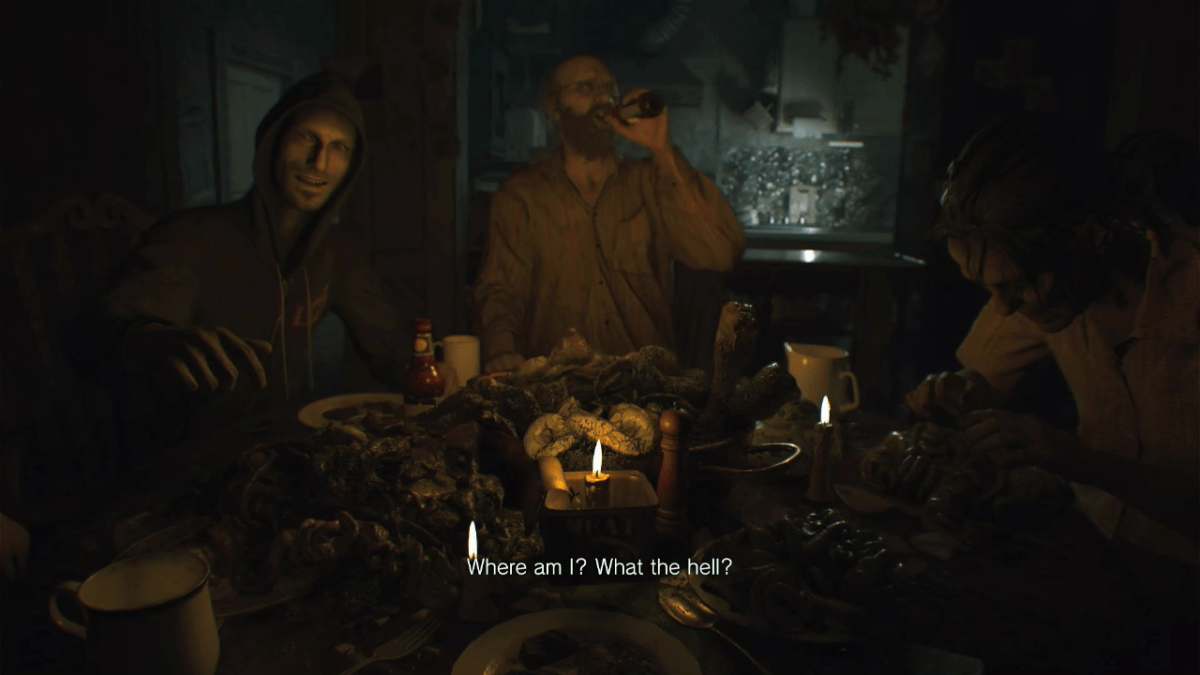
Shortly after trespassing into the abandoned Baker estate, you wake to find yourself sitting at the dining table surrounded by the family of psychotic redneck owners, the left hand that you’d just had chopped off stapled back on. It’s a surprising setting for a Resident Evil game, not only because you’re watching it all from protagonist Ethan Winter’s eyes, but because it fundamentally flips the series’ central ideas on their heads while being loyal to the core design. Rather than taking inspiration from schlocky western zombie flicks, Resident Evil 7 viewed its haunted house item progression and Condemned-esque first-person investigation gameplay to solve a country horror mystery inspired by Texas Chainsaw Massacre. Ethan escapes after dinner and kills Jack Baker when his car explodes, only to be grabbed again by fast healing Jack who blows his brains out for you in a show of his power. It’s here that the player realizes that Resident Evil 7: Biohazard, with its willingness to rethink the series on a cellular level, represents a different kind of coming back from the dead.
Continue reading “Biohazard Coming Home: When Survival Horror Returned for Resident Evil 7’s Family Reunion”Tag: 2017
Metroid’s Genealogy: What Samus Returns Reveals About a Series’ Evolving Design

Just as genes create an infinite number of organisms with only a few components, game series continually adjust their mechanics and structure to keep their designs fresh. Since its first release, the Alien-inspired Metroid series has dealt in biological themes including consumption, growth, and fusion, even when transitioning from 2D sprites to 3D polygons. But evolution is tricky as it risks sabotaging the design’s strengths, and after almost a dozen entries Metroid was in danger of bursting apart. Samus Returns is a remake that attempts to return to the series’ design on a cellular level by synthesizing its side-scrolling gameplay with polygons, reclaiming the genetic heritage that built the series and its heroine.
Continue reading “Metroid’s Genealogy: What Samus Returns Reveals About a Series’ Evolving Design”The Soul in Nier: Automata’s Machine

Human consciousness required tools that let it produce abundant resources so people could transition from simple survival to prosperity, which allowed humanity to further discover the world and find a place in it. Tools advanced into machines given more sophisticated logic, motor, and communication systems through developments in electronics, networking, and artificial intelligence. But a world is like a person- the more it becomes one thing, the less it’s like something else. Nier: Automata examines how machines are becoming the new owners of our world but will continue a tragic human legacy, by using videogames to give us a glimpse at how machine logic is coding its own soul.
Continue reading “The Soul in Nier: Automata’s Machine”A Platforming Odyssey: Running and Jumping Down the Path Super Mario Trail-Blazed
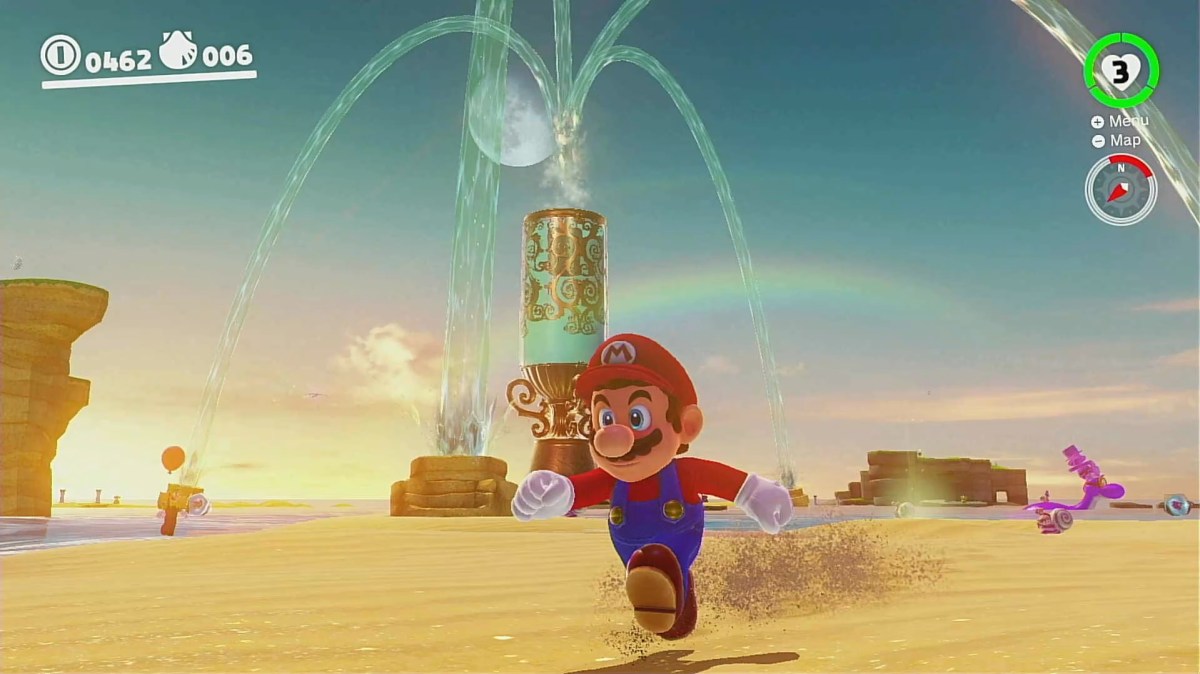
The concert in Super Mario Odyssey’s New Donk City is a celebration of one of videogame’s most influential series, sung by Pauline, the damsel-in-distress-turned-mayor from Donkey Kong. With the city freed from Bowser’s clutches, the festivities showcase Mario as he enters a warp pipe, transforms from 3D polygonal model into 2D sprite, and runs through a steel-beamed obstacle course packed with coins and lava pits, and ends with a barrel filled course thrown by the cranky ape. This homage pays tribute to Mario’s amazing history, and shows how Odyssey combines decades of level design techniques to create unique courses in living worlds.
Continue reading “A Platforming Odyssey: Running and Jumping Down the Path Super Mario Trail-Blazed”
