

In Miyamoto Musashi’s landmark The Book of Five Rings, the legendary Japanese swordsman illuminates a lifetime’s worth of martial arts philosophy, expressing the warrior archetype as a carpenter who must master all the tools of his trade to build a fortified defense in a world where violence has consequences. Videogames ability to convey those consequences allow for martial arts to be constructed through complex fighting systems, and in Samurai Shodown, SNK brought combatants from a dozen styles together in armed combat, creating beautiful and dynamic duels that blend hack and slash and beat ’em up combat into a single design that requires precision and patience to unleash strikes as sharp as your blade.
Continue reading “To Live and Die by the Blade in Samurai Shodown”Category: Systems
Parasite Eve (or, SquareSoft’s Experimental Cinematic RPG)

Aya Brea’s date night at Carnegie Hall is tragically cut short when the show’s new singer eyes her in the audience, activating an unknown ability deep in her cells that lights everyone in attendance on fire except the stunned NYPD detective who chases the mutated Eve backstage. The theater is a perfect place to start Parasite Eve’s story, as the game, inspired by survival horror games of the time, was SquareSoft’s experiment with cinematic techniques, using digital actors on its virtual stage. Since RPGs are fundamentally about surviving dungeons and harsh environments with the resources you have in your inventory, Parasite Eve was a great opportunity to experiment with new ideas. Directed by Takashi Tokita, veteran of Live A Live and Chrono Trigger, Parasite Eve is a cinematic police procedural that merges game genres to tell of the six day quest to stop Eve’s genetic awakening before it changes humanity forever.
Continue reading “Parasite Eve (or, SquareSoft’s Experimental Cinematic RPG)”Splicing Gen(r)es: Investigating Resident Evil’s Survival Horror
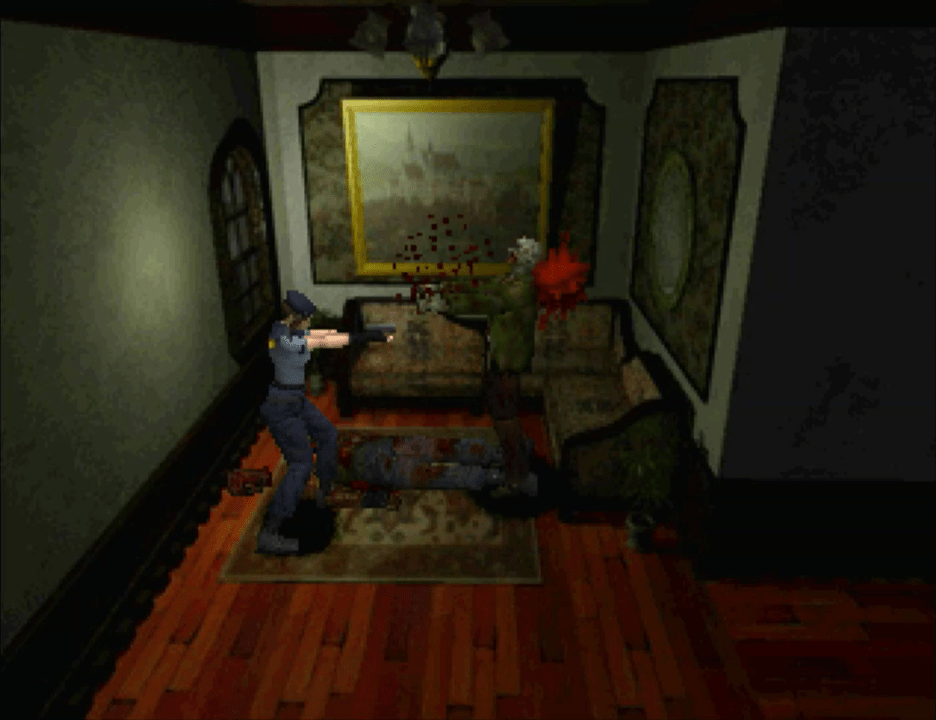
A Biohazard Outbreak
When Special Tactics And Rescue Squad’s Bravo team goes dark in Raccoon City’s Arklay Mountains while investigating grizzly murders, the Alpha team rescue party finds itself in a firefight against bloody claws and gnashing teeth, a scene Resident Evil brings to life with real actors dashing through the woods towards the safety of Spencer Mansion. Though primarily told through cinematic in-engine cutscenes framed by a static camera system, this live-action scene transitions the player into the B movie game’s world filled with zombies, mutated dogs, giant spiders, and, at the end, the perfect bioweapon, manufactured by the international conglomerate, Umbrella Inc. A controllable, branching B horror movie starring S.T.A.R.S.’ Chris Redfield or Jill Valentine and supporting characters, Resident Evil tests your delicious brain’s skills to survive a different kind of haunted house, discover the truth about a biological outbreak.
Continue reading “Splicing Gen(r)es: Investigating Resident Evil’s Survival Horror”Reclaiming the Peak: The Master Strokes Painting Street Fighter IV’s Martial Arts Canvas

If the original Street Fighter represented Ryu’s quest to climb the metaphorical mountain of martial arts mastery through willpower and multi-disciplined training, then Seth, Street Fighter IV’s boss, is the antithesis, an engineered creation that technologically combined the moves of the greatest fighters to leap straight to the top. By SFIII, the series’ core evolved into a deep combat model with flowing hip-hop style, but its complexity made the climb nearly insurmountable for new players at a time when gaming was going through dramatic changes. What was needed was a break until new tech could re-evaluate the series’ design and still capture its artistry. Street Fighter IV returned to the canvas nine years later, able to balance traditional gameplay elements from throughout the series to help fighters at any skill level reach the martial arts’ stunning, stylish summit.
Continue reading “Reclaiming the Peak: The Master Strokes Painting Street Fighter IV’s Martial Arts Canvas”Toy Commercial Meets Cartoon Maker, Transformers: Devastation Brilliantly Combines Genres into a G1 Powerhouse

The first chapter in Transformers: Devastation showcases the game’s strong design, pitting the Autobots led by Optimus Prime against the Constructicons. Transforming between their bot and alt forms, the Decepticon construction crew is deadly individually and tricky when grouped, and both sides unleash melee weapons and guns before transforming again and hitting turbo. These cool-looking cel-shaded animations allow Devastation to provide the tools to create awesome, exhilarating battles. And as the last Constructicon is defeated, they all combine into the mighty Devastator, helping Megatron cyberform Earth into their home planet, Cybertron. With Transformers: Devastation, Platinum Games provides virtual action figures so players can direct a never-aired episode of the legendary brand’s iconic G1 cartoon with heavy metal soundtrack.
Continue reading “Toy Commercial Meets Cartoon Maker, Transformers: Devastation Brilliantly Combines Genres into a G1 Powerhouse”The Warriors’ Dream: Analyzing The Alpha Systems That Transformed Street Fighter

A lot of thought goes into a videogame sequel to progress the gameplay and characters of the original, but its changes need to justify their existence while capturing the original’s intent. So, how do you meaningfully expand on a game like Street Fighter II that defined fighting gameplay, especially when its constant revisions resulted in five major arcade releases? One trick is to build new systems over the core gameplay, useful for when a genre like 2D fighting needs to modify elements without having to redraw character animations. Street Fighter Alpha shows how modular, swappable systems can dramatically change the foundation they are built onto, its new mechanics adding depth to Capcom’s fighting game formula while dramatically improving the presentation to create exhilarating, anime-caliber battles between fast, fluid, and powerful characters.
Continue reading “The Warriors’ Dream: Analyzing The Alpha Systems That Transformed Street Fighter”Training New World Warriors in Street Fighter’s Dojo

Street Fighter’s shotokan style was an important first archetype for a 1v1 fighting game and introduced Ryu and Ken to the world, but the game had too many weaknesses to sculpt a complete, well-rounded martial artist. Like a body maturing, its strength multiplying and nervous system connecting every part, it wasn’t until Capcom’s arcade hardware improved that it could fully realize the fighting depth and dramatic spectacle to which the original game aspired. But three and a half years would prove fruitful training time to address SF’s faults, and the result revolutionized videogames forever and debuted an iconic cast of diverse fighting styles. With its improved animation system, new character archetypes, and a third core mechanic that brilliantly merged the gameplay, Street Fighter II: The World Warrior’s eight playable fighters helped solidify Street Fighter’s martial art, and took its digital dojo global.
Continue reading “Training New World Warriors in Street Fighter’s Dojo”Surviving Deadline: An Exposé on Dead Rising’s Absurd Zombie Apocalypse

Survival depends on your ability to properly manage your supplies in a complex world where dangers lurk around every corner. With Dead Rising, Capcom reworked the survival horror concepts of its more famous zombie-fighting series to challenge players to survive three days against an endless mob of monsters and their own hunger. By fighting his way through the Rogue-like structured brawler, photojournalist Frank West will document an absurd horror-comedy about dying and coming back again.
Continue reading “Surviving Deadline: An Exposé on Dead Rising’s Absurd Zombie Apocalypse”Sports Game Triple Play: Evolving Pong’s Design Into Windjammers and Lethal League
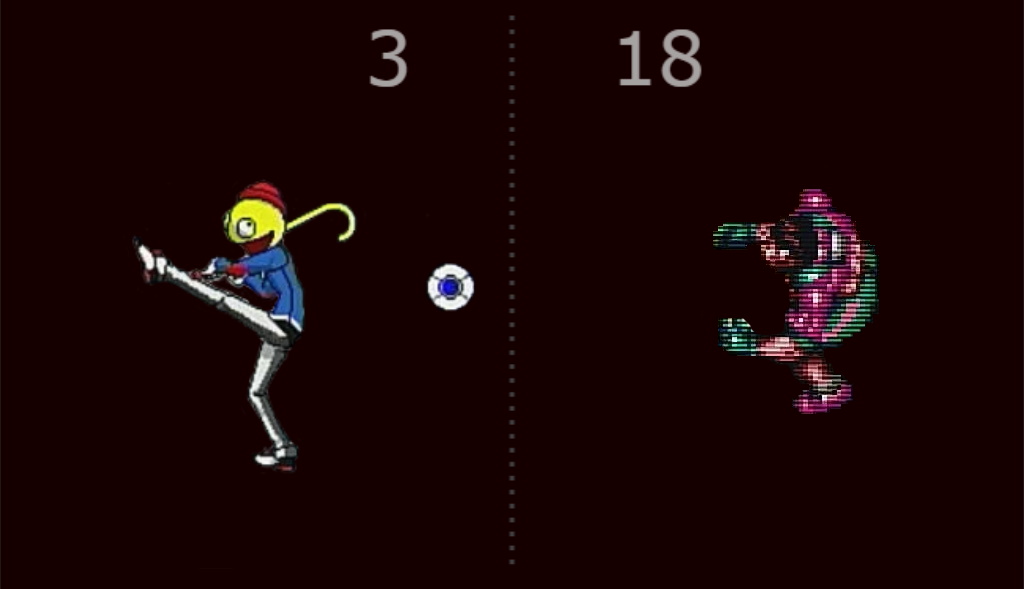
A game can take many forms. The history of videogames is packed with examples of games that started as simple versions of real life activities only for their designs to evolve into lifelike simulations of the original, but just as important is how different genres can be combined in infinite ways to make new styles. This is especially true of Pong’s iconic gameplay, turning the bouncing ball structure into the wildly different Windjammers and Lethal League while still retaining its spirit.
Seeing Adolescence Through The Eyes Of Majora’s Mask

An hour after he was locked in Clock Town, Link’s been turned into a Deku Scrub staring down a massive, fiery-eyed moon so close that he could pick its gritted teeth with his sword. Looming over him is Skull Kid, supercharged by the Majora’s Mask. Playing the Song of Time Zelda had entrusted him with to save Hyrule, Link returns to the exact moment he’d entered Clock Town, the moon again 72 in-game hours from destroying everything, the citizens back on their schedule as if the first round had been a bad dream.
Continue reading “Seeing Adolescence Through The Eyes Of Majora’s Mask”
 scriptroutine.com