

If the original Street Fighter represented Ryu’s quest to climb the metaphorical mountain of martial arts mastery through willpower and multi-disciplined training, then Seth, Street Fighter IV’s boss, is the antithesis, an engineered creation that technologically combined the moves of the greatest fighters to leap straight to the top. By SFIII, the series’ core evolved into a deep combat model with flowing hip-hop style, but its complexity made the climb nearly insurmountable for new players at a time when gaming was going through dramatic changes. What was needed was a break until new tech could re-evaluate the series’ design and still capture its artistry. Street Fighter IV returned to the canvas nine years later, able to balance traditional gameplay elements from throughout the series to help fighters at any skill level reach the martial arts’ stunning, stylish summit.
Continue reading “Reclaiming the Peak: The Master Strokes Painting Street Fighter IV’s Martial Arts Canvas”Category: Xbox 360
Toy Commercial Meets Cartoon Maker, Transformers: Devastation Brilliantly Combines Genres into a G1 Powerhouse

The first chapter in Transformers: Devastation showcases the game’s strong design, pitting the Autobots led by Optimus Prime against the Constructicons. Transforming between their bot and alt forms, the Decepticon construction crew is deadly individually and tricky when grouped, and both sides unleash melee weapons and guns before transforming again and hitting turbo. These cool-looking cel-shaded animations allow Devastation to provide the tools to create awesome, exhilarating battles. And as the last Constructicon is defeated, they all combine into the mighty Devastator, helping Megatron cyberform Earth into their home planet, Cybertron. With Transformers: Devastation, Platinum Games provides virtual action figures so players can direct a never-aired episode of the legendary brand’s iconic G1 cartoon with heavy metal soundtrack.
Continue reading “Toy Commercial Meets Cartoon Maker, Transformers: Devastation Brilliantly Combines Genres into a G1 Powerhouse”The Rise of Hyper-Fighting: How Capcom Combo’d Innovative Mechanics Into An Intense Anime Versus Subgenre

Iterating gameplay is a crucial part of the videogame design process to streamline the strong elements and improve the weaker, especially important for competitive genres where devs balance thousands of different aspects to make it fair. But with a game’s subsequent releases, a developer risks changing the base structure too much and making it unrecognizable. For a legendary game like Street Fighter II, which established fighting game’s rock/paper/scissors blueprint, balancing new ideas is incredibly challenging, even for a game notorious for its many revisions. The smart move would be to start with a fresh series to safely experiment with new gameplay, powered by new tech. In the mid 1990’s, Capcom branched out, resulting in more than a dozen games that would not only establish All-Star and Tag-Team fighting games, but create a new standard for a combat system’s actions-per-minute. These games would cultivate a lightning-fast subgenre that captured the spirit of Shōnen anime, complete with fast combat, air combos, and glorious super moves, with the beloved Marvel vs Capcom series its star.
Continue reading “The Rise of Hyper-Fighting: How Capcom Combo’d Innovative Mechanics Into An Intense Anime Versus Subgenre”Integrating With Zone of the Enders’ Man-Machine Interface
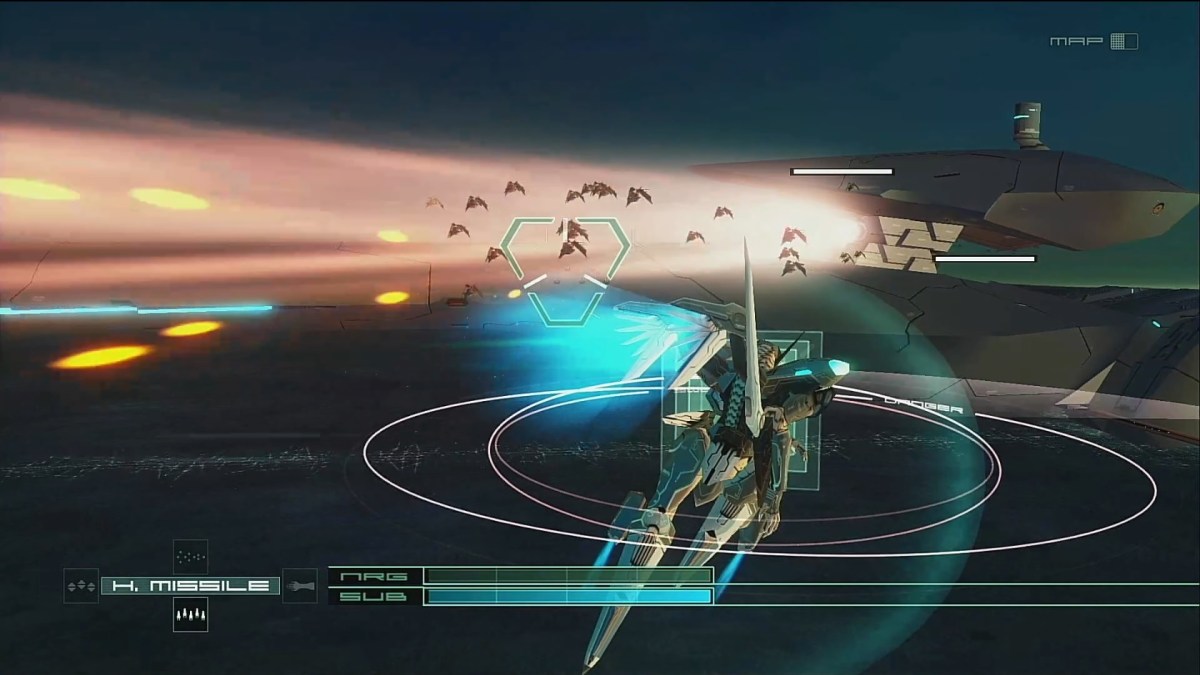
The five destroyers in BAHRAM’s air armada equipped with particle cannons and support turrets are perfect for wiping out any who oppose the political faction, and only a high-performance super machine that combines an artificial intelligence with human ingenuity can overcome it. In Zone of the Enders: The 2nd Runner, you systematically breach this fleet by unleashing locked-on lasers and homing missiles, and melt the ships’ cores with point blank fire from your high-output Vulcan Cannon. The battle above Vascillia is an epic mission that requires man and machine to harmonize into one being, and represents the important relationship that has built between the two.
Continue reading “Integrating With Zone of the Enders’ Man-Machine Interface”Surviving Deadline: An Exposé on Dead Rising’s Absurd Zombie Apocalypse

Survival depends on your ability to properly manage your supplies in a complex world where dangers lurk around every corner. With Dead Rising, Capcom reworked the survival horror concepts of its more famous zombie-fighting series to challenge players to survive three days against an endless mob of monsters and their own hunger. By fighting his way through the Rogue-like structured brawler, photojournalist Frank West will document an absurd horror-comedy about dying and coming back again.
Continue reading “Surviving Deadline: An Exposé on Dead Rising’s Absurd Zombie Apocalypse”Psychoanalyzing Batman: Arkham Asylum’s Multiple Personalities

Where a story needs to give its characters the abilities to accomplish their goals, a videogame needs to directly translate those skills into mechanics players use to overcome every obstacle in their way. Both mediums use tools that challenge characters, one of the most powerful of which is creating a rival that fiercely stands in opposition to their primary mission. In 2009, Rocksteady Studios fully translated one of pop culture’s greatest characters into a videogame and pitted him against his equally well-established foil. By locking Batman and The Joker inside Gotham’s mental-clinic-turned-prison, Batman: Arkham Asylum brilliantly explores one of culture’s greatest rivalries over one long night.
Continue reading “Psychoanalyzing Batman: Arkham Asylum’s Multiple Personalities”Running Perfect Dark’s Training Program
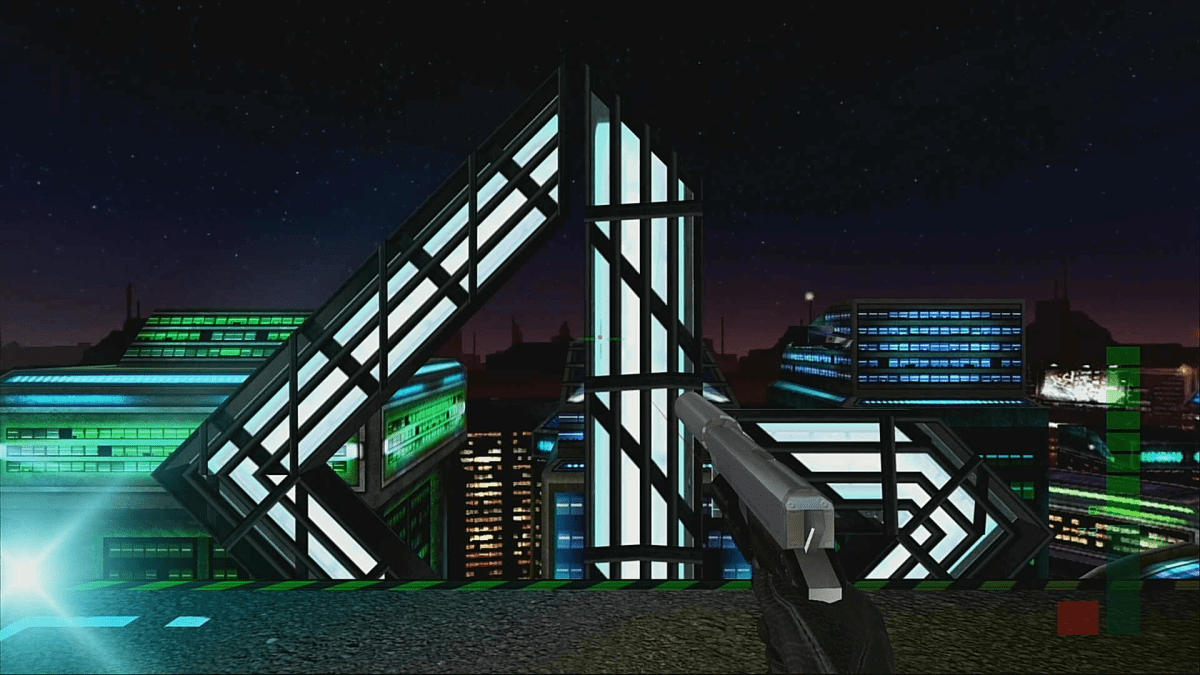
Early first person shooters created virtual proving grounds for an emerging digital warrior class to test their combat skills, but as games became more intricate, new player archetypes branched out. By the end of the Nintendo 64’s life, Rare had learned to construct complex environments built with infrastructure stalked by reactive guards, while providing players with a large toolset to deal with them. The product turned them into versatile special agents rather than warriors, culminating in 2000’s brilliant Perfect Dark.
Perfect Dark’s intricacies are apparent as early as the first level. Your mission to smuggle the defecting Dr. Carroll from dataDyne is easy on the lowest difficulty, only asking you to reach the bottom of its tower, but adds more objectives that explain the whistleblower’s actions from there. The opening helipad leads down to the executive floors and this large office with two women. If you quickly knock out the tall blonde calling for security you’ll get Cassandra De Vries necklace, smartly introducing dataDyne’s CEO.
Continue reading “Running Perfect Dark’s Training Program”Scoring Devil May Cry 4’s Smokin’ Sick Style

Devil May Cry may be revered for merging fighting game’s pugilist science with brawler’s crowd management, but it was driven by its arcade-inspired scoring system. Dedicated fans can easily spend dozens of hours honing their skills against the game’s difficult enemies and massive bosses, all to improve their final scores. With DMC3, Hideaki Itsuno expanded the single player fighting game’s combat and worked in replayable missions. When that amazing foundation jumped to the PS3 and Xbox360 for the fourth release, Itsuno could further distill the series down into an arcade experience and offer new characters for those chasing that high score high. Let’s look at how it succeeds.
Continue reading “Scoring Devil May Cry 4’s Smokin’ Sick Style”
Devil May Cry 3: Bearing Witness To Dante’s Awakening
On Characterizing Potential
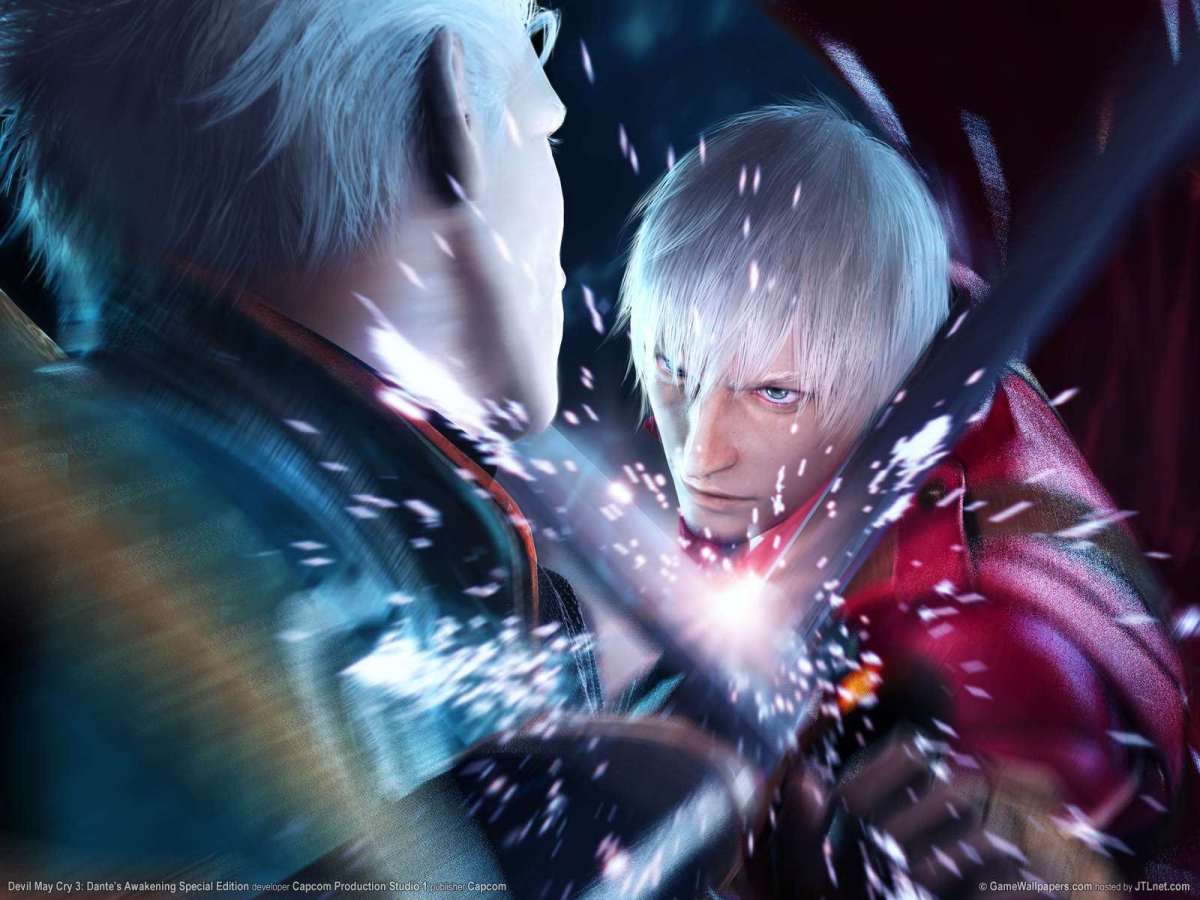
Devil May Cry 3’s first fight between the twins Dante and Vergil is set at the highest point of a large tower jabbing from the Earth, lit by the full moon. The differences between the brothers’ fighting styles are as striking as their fashion senses, the hot-headed Dante in his red trench coat unleashing his Rebellion sword and dual pistols a contrast to the cool-as-ice Vergil in his blue jacket and air slicing katana, Yamato. The two rivals clash swords and exchange gunfire, taking advantage of any opening in the other’s defense to chop ‘em down. And then they flaunt their success with a cool taunt, unconcerned by the time it takes to mock their opponent. Every second of this brawl is intense and fast, and, by product of the game’s design, requires the player to fully realize the personalities of the sons of the legendary demon warrior Sparda.
Continue reading “Devil May Cry 3: Bearing Witness To Dante’s Awakening”
Shoulder to Shoulder We Find Our Way Through Lost Planet 2

Even after the snow had melted on the harsh planet E.D.N. III, Thermal Energy is such a scarce commodity that the scattered human factions are still locked in a brutal war for its reserves, a conflict that further leaves them vulnerable to attacks from the insectroid race of Akrids native to the land. Of course, when a load of T-Eng is being transported by train, a worm-like beast attacks that is so massive, it dwarfs the four people that are forced to fight it back, even with the racks of weapons littered about. As it takes out the rear cars and any player left behind, the only thing that can counter its immense size is the cumulative strength of those standing against it, all focusing their fire into its mouth and tender insides. And when the worm finally falls, the group makes off with the spoils. With its in-mission economy, Lost Planet 2 portrays an ecological system reminiscent of Frank Herbert’s Dune, showing that, on E.D.N., every second is a fight to survive. It’s a metaphor ripped from the history books of every life form that’s ever lived.
Continue reading “Shoulder to Shoulder We Find Our Way Through Lost Planet 2”
 scriptroutine.com