

With its rhythmic striking system that hits at different heights, Street Fighter‘s combat system was expanded to become a branching, freestyle duet in SFII, sung by the sound effects and character voice samples. After Street Fighter Alpha’s swappable systems pushed the series’ fighting game formula to it’s limits, Capcom streamlined its base mechanics and meter functions for Street Fighter III, using the CPS-3’s CD format for gritty, stylized art on detailed stages against a funky soundtrack. Street Fighter III: New Generation’s refined mechanics maxed its beats per minute and rewarded improvisation, turning it into a fluid hip-hop fighting game.
Continue reading “Mixin’ Knock Out Beats in Street Fighter III’s Hip-Hop Battles”Category: <3
The Warriors’ Dream: Analyzing The Alpha Systems That Transformed Street Fighter

A lot of thought goes into a videogame sequel to progress the gameplay and characters of the original, but its changes need to justify their existence while capturing the original’s intent. So, how do you meaningfully expand on a game like Street Fighter II that defined fighting gameplay, especially when its constant revisions resulted in five major arcade releases? One trick is to build new systems over the core gameplay, useful for when a genre like 2D fighting needs to modify elements without having to redraw character animations. Street Fighter Alpha shows how modular, swappable systems can dramatically change the foundation they are built onto, its new mechanics adding depth to Capcom’s fighting game formula while dramatically improving the presentation to create exhilarating, anime-caliber battles between fast, fluid, and powerful characters.
Continue reading “The Warriors’ Dream: Analyzing The Alpha Systems That Transformed Street Fighter”Training New World Warriors in Street Fighter’s Dojo

Street Fighter’s shotokan style was an important first archetype for a 1v1 fighting game and introduced Ryu and Ken to the world, but the game had too many weaknesses to sculpt a complete, well-rounded martial artist. Like a body maturing, its strength multiplying and nervous system connecting every part, it wasn’t until Capcom’s arcade hardware improved that it could fully realize the fighting depth and dramatic spectacle to which the original game aspired. But three and a half years would prove fruitful training time to address SF’s faults, and the result revolutionized videogames forever and debuted an iconic cast of diverse fighting styles. With its improved animation system, new character archetypes, and a third core mechanic that brilliantly merged the gameplay, Street Fighter II: The World Warrior’s eight playable fighters helped solidify Street Fighter’s martial art, and took its digital dojo global.
Continue reading “Training New World Warriors in Street Fighter’s Dojo”How Metal Gear Solid Integral Upgraded Solid Snake’s Simulation

Lessons Learned
Metal Gear Solid’s post credit scene reveals that the nuclear-equipped Metal Gear Rex’s test data survived Solid Snake’s missiles, its log an invaluable learning experience for the developers. Similarly, snaking through the occupied Shadow Moses military base where Rex was developed required a lot of in-the-field training and dozens of hours, rations, and Game Overs, stats the game totals onscreen at its end. Of course, this is all created by a third set of data, the combined mechanics, systems, art, scripts, and modes that are the game. If the elements in Hideo Kojima’s classic thriller supports the theme of biological evolution, the very existence of its 1999 special edition, Metal Gear Solid Integral, tells us much about the new worlds that technological evolution is building for us, even on societal levels, as it upgrades its digital bootcamp to MGS version 1.2.
Continue reading “How Metal Gear Solid Integral Upgraded Solid Snake’s Simulation”Devil May Cry And How Character Action Burst Onto The Gaming Scene In Style

The character action genre is hard to fully define considering how wildly different one title can be from the next, but it largely comes from the stylish combat defined by Capcom’s 2001 milestone, Devil May Cry. DMC’s action design was so strong that it could seamlessly transition between melee and ranged combat, where you can launch an enemy into the air with your sword and juggle them with gunfire. These fast fights are made from a simple yet complete moveset that works well at different distances. Director Hideki Kamiya translated hack ‘n slash games and brawlers into three dimensions, emphasizing twitch action and fair but challenging difficulty by imbuing it with fighting game mechanics and systems that grade your performance in real time. It offers players the means to create spectacular combat sequences where the goal isn’t just to defeat your enemy but to stylishly wreck them.
To understand how it all came together, we have to look at DMC’s family tree.
Continue reading “Devil May Cry And How Character Action Burst Onto The Gaming Scene In Style”Unleashing The Wonderful 101’s Box of Action Figures

Action games are complex ways of playing with action figures, equipping the one connected to your controller with more than just karate-chop action to live out heroic battles against evil. These figures have always been a great way to let a show or comic’s fans act out their favorite character’s stories, but videogames directly provide the means to embark on adventure. Unfortunately, both games and figures have a problem with how many characters a player can hold at once, but Hideki Kamiya’s The Wonderful 101 lets you simultaneously control an army through a season long television show that proves that even the smallest heroes can defeat galactic threats if they unite.
Continue reading “Unleashing The Wonderful 101’s Box of Action Figures”Atmospheric Pressure: Navigating Metroid Dread’s Oppressive Depths

If Metroid has a central emotion, it’s a claustrophobic anxiety created by its desolate, foreboding atmosphere. The original game used ambient music and otherworldly imagery to choke the player as they descended into the planet Zebes and subsequent titles further explored the sense of anxiety, but it wasn’t until Metroid Fusion that the series characterized the threat, creating a strong foe that stalked Samus Aran and actively pushed the bounty hunter back on her heels. While this SA-X was a great way to mirror Samus’ abilities and turn the classic weapons back at you, its scripted appearance and limited scope left a lot of room for improvement. But with Metroid Dread, the series was finally able to make a fully reactive A.I. that nimbly navigates the environment to stalk Samus, instilling a gripping paranoia into the gameplay unlike it had seen before.
Continue reading “Atmospheric Pressure: Navigating Metroid Dread’s Oppressive Depths”Integrating With Zone of the Enders’ Man-Machine Interface
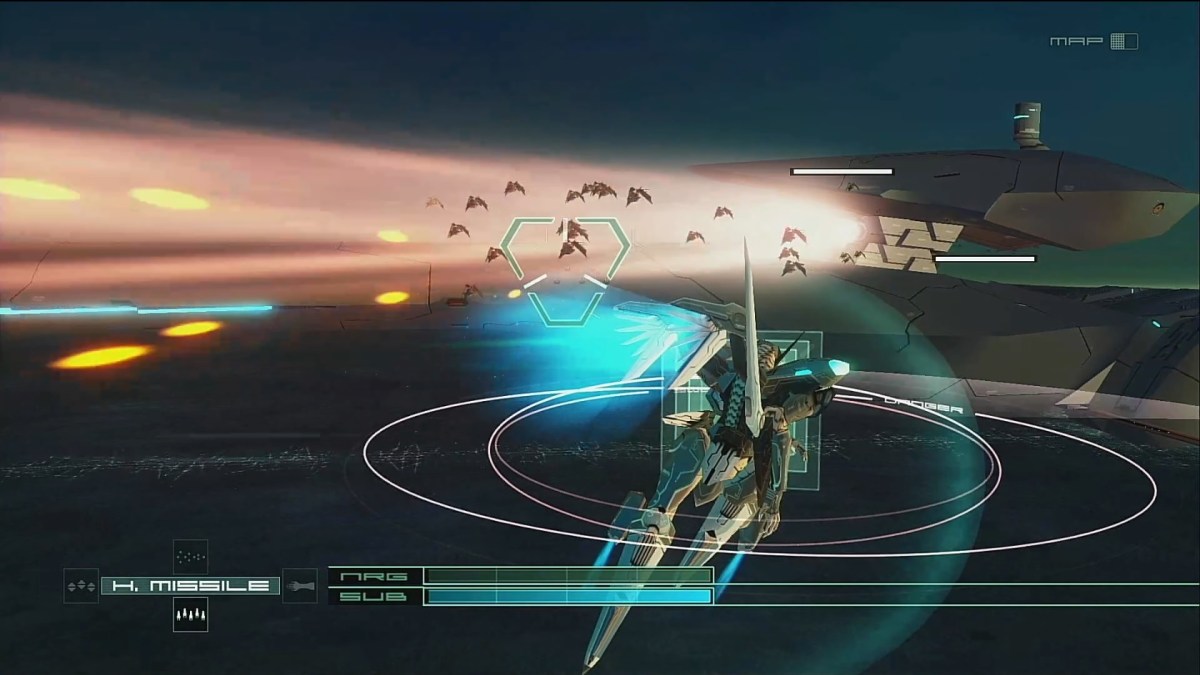
The five destroyers in BAHRAM’s air armada equipped with particle cannons and support turrets are perfect for wiping out any who oppose the political faction, and only a high-performance super machine that combines an artificial intelligence with human ingenuity can overcome it. In Zone of the Enders: The 2nd Runner, you systematically breach this fleet by unleashing locked-on lasers and homing missiles, and melt the ships’ cores with point blank fire from your high-output Vulcan Cannon. The battle above Vascillia is an epic mission that requires man and machine to harmonize into one being, and represents the important relationship that has built between the two.
Continue reading “Integrating With Zone of the Enders’ Man-Machine Interface”Surviving Deadline: An Exposé on Dead Rising’s Absurd Zombie Apocalypse

Survival depends on your ability to properly manage your supplies in a complex world where dangers lurk around every corner. With Dead Rising, Capcom reworked the survival horror concepts of its more famous zombie-fighting series to challenge players to survive three days against an endless mob of monsters and their own hunger. By fighting his way through the Rogue-like structured brawler, photojournalist Frank West will document an absurd horror-comedy about dying and coming back again.
Continue reading “Surviving Deadline: An Exposé on Dead Rising’s Absurd Zombie Apocalypse”Psychoanalyzing Batman: Arkham Asylum’s Multiple Personalities

Where a story needs to give its characters the abilities to accomplish their goals, a videogame needs to directly translate those skills into mechanics players use to overcome every obstacle in their way. Both mediums use tools that challenge characters, one of the most powerful of which is creating a rival that fiercely stands in opposition to their primary mission. In 2009, Rocksteady Studios fully translated one of pop culture’s greatest characters into a videogame and pitted him against his equally well-established foil. By locking Batman and The Joker inside Gotham’s mental-clinic-turned-prison, Batman: Arkham Asylum brilliantly explores one of culture’s greatest rivalries over one long night.
Continue reading “Psychoanalyzing Batman: Arkham Asylum’s Multiple Personalities” scriptroutine.com